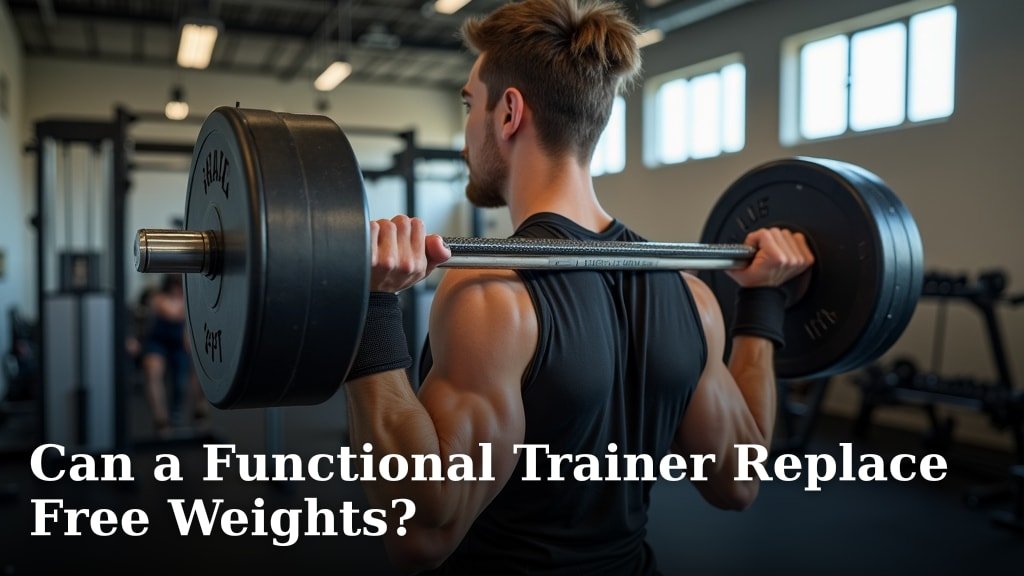
Yes, a functional trainer can definitely replace free weights for many exercises. It offers a wide range of motion and helps you work multiple muscles at once. You can get a complete workout with just a functional trainer.
Many fitness experts agree that functional trainers are incredibly versatile. They allow for dynamic, sport-specific movements that free weights sometimes can’t. Plus, they offer constant tension throughout the exercise, which is great for building strength and endurance. Are you looking to replace your whole gym with one machine? We found that functional trainers come pretty close.
- Functional trainers offer great versatility.
- They can replace many free weight exercises.
- You get constant muscle tension.
- They are good for building strength and endurance.
- Perfect for dynamic, real-world movements.
Let’s dive into the details and see how a functional trainer stacks up against traditional free weights.
Functional Trainers Versus Free Weights: A Comparison
You’re wondering if a functional trainer can truly stand in for free weights. The short answer is yes, in many cases. Both offer excellent ways to build strength and muscle. But they do so in different ways. Let’s look at how they stack up. We’ll explore their pros and cons for your fitness journey.
The Unique Advantages of Functional Trainers
Functional trainers are like a playground for your muscles. They use a system of cables and pulleys. This creates a constant tension. This tension is present throughout the entire movement. Free weights, on the other hand, often have varying tension. Gravity dictates the resistance with free weights.
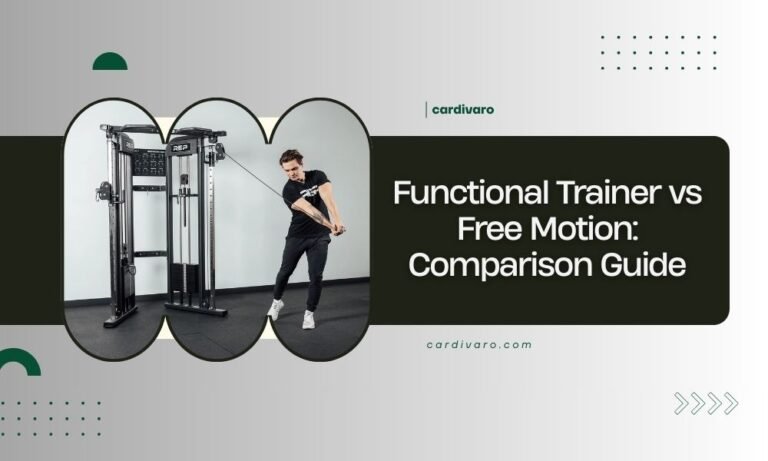
One big plus for functional trainers is their versatility. You can perform hundreds of exercises. Think squats, rows, presses, and even rotational movements. This machine allows you to mimic real-world activities. This training is called “functional” because it helps you move better in everyday life. Many athletes use them for sport-specific training. They can simulate a golf swing or a tennis serve, for instance.
Another advantage? Safety. It’s often easier to control the weight. You can adjust it in small increments. This reduces the risk of injury compared to lifting heavy free weights. There’s no need for a spotter for many exercises. If you need to stop, you just let go. The weights stay safely in their stack.
Where Free Weights Still Shine
Free weights, like dumbbells and barbells, are fitness classics. They offer a unique benefit: stabilizer muscle activation. When you lift a free weight, your body works harder. It has to balance the load. This activates smaller, supporting muscles. These muscles help you maintain control. This leads to overall greater strength development.
Another point for free weights is their simplicity and accessibility. A set of dumbbells or a barbell with plates is straightforward. There are no complex settings. You just pick them up and lift. We found that free weights are a staple in almost every gym. They are also relatively inexpensive for a home gym setup.
For maximizing muscle growth, often called hypertrophy, free weights can be very effective. You can typically lift heavier loads. This places more stress on the muscle. More stress can lead to greater muscle growth over time. Many powerlifters and bodybuilders rely heavily on free weights.
Direct Exercise Comparisons
Let’s consider some common exercises. How do they differ between the two types of equipment? This can help you see which might be better for your goals.
Squats: Form and Function
With a barbell squat, the weight is on your back or shoulders. This position forces your core and many other muscles to stabilize. It’s a fantastic compound exercise for building overall leg strength. You lift the weight directly against gravity.
On a functional trainer, you can do cable squats. You might hold handles at chest level. The resistance comes from the cables pulling forward. This can feel different. It creates a more even tension throughout the movement. It also puts less direct load on your spine. This can be great for those with back concerns.
Chest Press: Push for Strength
A dumbbell or barbell bench press is a staple. It builds chest, shoulder, and triceps strength. Your body works to stabilize the weight. This is especially true with dumbbells. Each arm works independently.
With a functional trainer, you can do cable chest presses. You stand in the middle of the machine. You push the handles forward. This gives you a smoother, more controlled movement. It keeps tension on your muscles even at the top of the movement. This is when free weight tension often decreases (National Strength and Conditioning Association).
Rows: Pull for Your Back
Barbell rows or dumbbell rows are excellent for back development. They challenge your stability. You have to maintain your posture while pulling the weight towards you. This engages many different muscle groups.
Functional trainer rows, like cable seated rows, offer a clean pull. The resistance is consistent. It allows you to focus purely on contracting your back muscles. You can also perform standing cable rows. These engage your core more as you resist the pull of the cables.
| Feature | Functional Trainer | Free Weights |
|---|---|---|
| Resistance Type | Constant tension (cables) | Gravity-dependent (variable tension) |
| Movement Patterns | Multi-planar, functional, rotational | Mostly linear, compound lifts |
| Stabilizer Muscles | Less direct activation | High activation |
| Safety for Solo Use | Generally high (no spotter needed) | Lower for heavy lifts (spotter often needed) |
| Space Requirement | Moderate to large footprint | Can be small (dumbbells) to large (racks) |
| Beginner Friendliness | High (controlled movements) | Moderate (requires form learning) |
Benefits Beyond Basic Strength: Why Functional Training Matters
Functional training goes beyond just lifting heavy things. It’s about training your body for life. It helps you move better, prevent injuries, and perform daily tasks with ease. This is why many physical therapists use functional movements in rehabilitation.
Improved Stability and Balance
Functional trainers often involve exercises where you stand. You might be performing movements on one leg. This challenges your balance. It forces your core to work harder. Better balance helps prevent falls as you age. It also makes you more agile in sports (American Council on Exercise).
Think about carrying groceries. Or playing with your kids. These are functional movements. Training with a functional trainer helps you perform these tasks better. It enhances your body’s ability to stabilize itself. This is a crucial aspect of overall fitness.
Dynamic and Rotational Movement Training
Life isn’t always up and down. We twist, turn, and rotate. Free weights can be restrictive in these planes of motion. A functional trainer, with its cables, allows for full 360-degree movements. You can perform wood chops or torso rotations. These are hard to do safely with free weights.
Training in multiple planes helps your body become more resilient. It prepares you for unexpected movements. It also builds strength in ways that traditional linear lifts might miss. This can be especially important for athletes. It helps them perform specific movements in their sport.
Joint Health and Injury Prevention
The smooth, controlled resistance of a functional trainer can be gentler on your joints. There’s less jarring impact. This is unlike some free weight exercises. It allows for a full range of motion without putting excessive stress on vulnerable areas. This can be very beneficial if you have existing joint issues.
By strengthening all the muscles around a joint, functional training helps stabilize it. Stronger supporting muscles mean better joint protection. We found that incorporating functional movements can reduce the risk of injury. It does so by creating a more balanced and robust muscular system.
Is a Functional Trainer the Right Choice for Your Home Gym?
Considering adding a functional trainer to your home gym? It’s a big decision. Let’s look at what factors might make it perfect for you. Or, perhaps, when free weights might be a better fit.
Space and Budget Considerations
Functional trainers are typically single, large machines. They take up a fair amount of floor space. Make sure you have enough room for the machine itself. You also need space around it to move freely. Consider the ceiling height too, for overhead exercises.
The initial cost of a good functional trainer can be higher than a basic set of free weights. However, think about its long-term value. It’s a versatile piece of equipment. It can replace several other machines. For many, the investment is worth the convenience and range of exercise options.
Your Fitness Goals and Preferences
What are you hoping to achieve with your workouts? If your goal is general fitness, strength, and improved movement, a functional trainer is excellent. If you want to train for powerlifting or bodybuilding, you might still need significant free weights.
Do you enjoy varied workouts? Do you like trying new exercises? A functional trainer offers incredible variety. If you prefer simple, heavy lifts, free weights might be your preference. It really comes down to your personal style and what keeps you motivated.
A Checklist for Your Decision
- Do you have enough dedicated space for a larger machine?
- Is your budget flexible for an investment in a versatile machine?
- Are your main goals improving overall movement, balance, and core strength?
- Do you value consistent muscle tension throughout movements?
- Would you prefer a safer option for solo workouts without a spotter?
- Are you looking for a single machine that offers a wide range of exercises?
Conclusion
You’ve seen how functional trainers offer amazing versatility and constant tension. They shine for functional movements, safety, and joint health. While free weights still hold their own for heavy lifting and stabilizer activation, a functional trainer can capably handle most of your strength and conditioning needs. Consider your space, budget, and fitness goals carefully. We found that for overall fitness, improved movement, and dynamic training, a functional trainer is a genuine contender to lead your home gym.
Ready to make your choice? Weigh these factors against your daily routine and what inspires you to move. You’ll build a stronger, more capable you.
Frequently Asked Questions
Can a functional trainer replace all free weight exercises?
No, a functional trainer can replace many, but not all, free weight exercises. It excels at multi-planar and functional movements. However, for maximum heavy lifting and stabilizer muscle activation in traditional compound moves, free weights often remain superior. Think of it as a highly capable alternative, not a 100% identical substitute.
Is a functional trainer good for building muscle mass?
Yes, a functional trainer is effective for building muscle mass, especially for hypertrophy (muscle growth). The constant tension throughout movements challenges your muscles differently than free weights. While you might not lift the absolute heaviest loads, you can still create significant muscle-building stimulus.
Do functional trainers provide a full-body workout?
Absolutely! A functional trainer allows you to target every major muscle group in your body. From legs and core to chest, back, and arms, its versatility enables a complete full-body workout. You can perform pushes, pulls, squats, rows, and rotational movements all on one machine.
Are functional trainers beginners friendly?
Yes, functional trainers are very beginner-friendly. The controlled nature of cable movements reduces the risk of injury. You can easily adjust the resistance in small increments. This makes it easier to learn proper form before progressing to heavier weights, building confidence as you go.
How much space do I need for a functional trainer?
Functional trainers vary in size, but they generally require a moderate to large footprint. Plan for enough space for the machine itself, plus ample room around it (at least a few feet on each side). This ensures you can move freely and safely perform all exercises without feeling cramped.