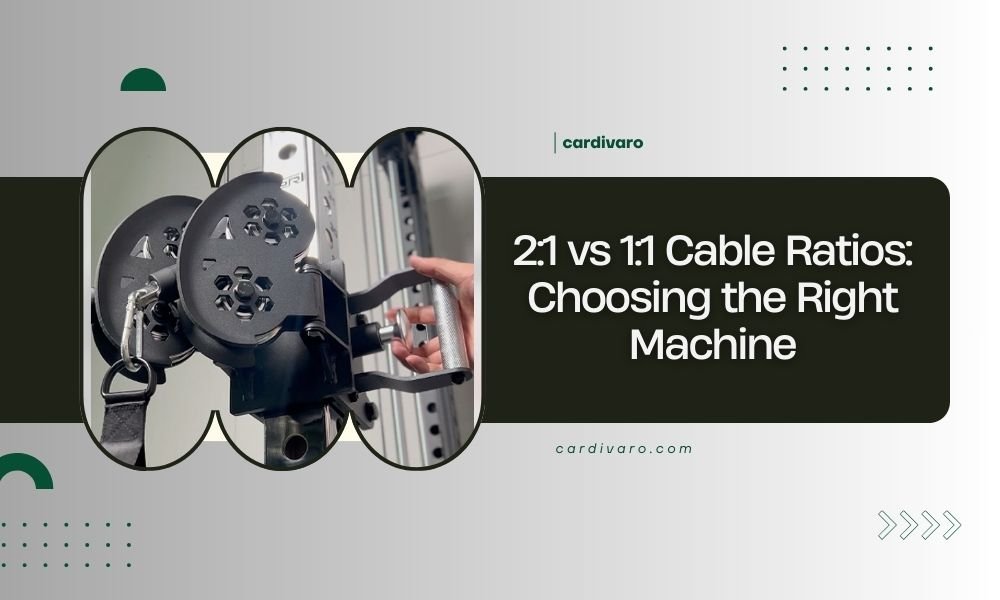
A 2:1 cable ratio means you pull twice as much cable as the weight travels, giving you smoother motion but cutting your lifting weight in half compared to a 1:1 system.
A 1:1 cable ratio provides direct weight transfer where every pound you select equals the resistance you feel, making it ideal for serious strength training and progressive overload.
What Cable Ratios Actually Mean
Think of cable ratios like a pulley system in your garage. When you use multiple pulleys to lift something heavy, you trade distance for easier pulling.
Cable machines work the same way. The ratio tells you how the weight stack connects to your cable handle.
How 2:1 Systems Work
In a 2:1 setup, the cable wraps around extra pulleys. When you pull two feet of cable, the weight stack only moves one foot.
This means if you select 100 pounds on the stack, you only feel 50 pounds of resistance. The system cuts the weight in half but gives you smoother movement.
How 1:1 Systems Work
A 1:1 system connects more directly. When you pull one foot of cable, the weight moves one foot.
Select 100 pounds, and you get 100 pounds of resistance. No reduction, no extra smoothness.
The Real Difference in Your Workouts
I researched functional trainers from major brands and found the ratio affects your entire training experience.
Weight Selection Reality
With a 2:1 machine, you need a 200-pound weight stack to get 100 pounds of resistance. Many people don’t realize this when shopping.
With a 1:1 machine, a 200-pound stack gives you the full 200 pounds. You get more bang for your buck in terms of available weight.
Movement Quality
The 2:1 ratio creates smoother motion because of the extra pulleys. You feel less jerky starts and stops.
The 1:1 ratio feels more direct and responsive. Every small movement translates immediately to the weight stack.
Who Should Choose 2:1 Ratios
I found that 2:1 systems work best for specific types of users and goals.
Rehabilitation and Physical Therapy
Physical therapists often prefer 2:1 systems because they provide gentler, more controlled movements. The smoothness helps people recovering from injuries.
The reduced weight also makes it easier to work with very light resistances for early-stage rehab.
Functional Movement Training
If you focus on movement patterns rather than heavy lifting, 2:1 ratios shine. They allow fluid motions that mimic real-world activities.
Sports-specific movements like golf swings or tennis serves feel more natural with the smoother cable action.
Older Adults and Beginners
The gentler feel of 2:1 systems makes them less intimidating for new users. The smoother operation reduces the chance of jerky movements that could cause injury.
Easier Weight Adjustments
When you need very light resistance, 2:1 systems give you more options. A 20-pound stack setting provides 10 pounds of actual resistance.
Who Should Choose 1:1 Ratios
From what I read in fitness equipment reviews, serious lifters gravitate toward 1:1 systems for good reasons.
Strength Training Focus
If building muscle and strength is your main goal, 1:1 ratios give you access to heavier weights without needing massive weight stacks.
Progressive overload becomes easier when you can add weight in smaller increments that actually matter.
Home Gym Space Limitations
Compact functional trainers often use 1:1 ratios because they can’t fit huge weight stacks. You get more resistance from smaller machines.
Budget Considerations
Generally, 1:1 machines cost less to manufacture because they need fewer pulleys and hardware. You often get more resistance for your money.
Athletes and Advanced Users
Competitive athletes usually prefer the direct feedback of 1:1 systems. The immediate response helps with explosive movements and power training.
Advanced lifters also need access to heavier weights that 1:1 systems provide more efficiently.
Comparing Popular Machines
I came across data from major manufacturers showing how they implement these different ratios.
| Machine Type | Common Ratio | Max Effective Weight | Best For |
|---|---|---|---|
| Premium Functional Trainers | 2:1 | 75-100 lbs per side | Smooth movement, rehab |
| Compact Home Gyms | 1:1 | 150-200 lbs per side | Strength training, space saving |
| Commercial Cable Machines | 1:1 | 200+ lbs per side | Heavy lifting, athletic training |
Making Your Decision
Your choice comes down to matching the machine to your primary goals and situation.
Ask Yourself These Questions
Do you need to lift heavy weights regularly? If yes, lean toward 1:1 ratios.
Are you focused on movement quality over maximum resistance? Consider 2:1 systems.
How much space and budget do you have? Compact 1:1 machines often provide more value in smaller spaces.
Test Before You Buy
If possible, try both types at a fitness equipment store or gym. The feel difference is immediately noticeable.
Pay attention to how each system responds to your movements and which feels more comfortable for your typical exercises.
Consider Hybrid Options
Some modern functional trainers let you switch between ratios or use different ratios for different attachments.
These systems cost more but give you flexibility as your fitness needs change over time.
Common Misconceptions
Many people think 2:1 ratios are always better because they cost more. That’s not necessarily true for your specific needs.
The “Professional” Assumption
Just because commercial gyms use certain ratios doesn’t mean they’re right for your home setup. Commercial equipment serves different needs.
Weight Stack Confusion
Don’t just look at the weight stack size. Calculate the actual resistance you’ll get based on the ratio.
A 150-pound stack with 1:1 ratio gives you more resistance than a 200-pound stack with 2:1 ratio.
Conclusion
Your choice between 2:1 and 1:1 cable ratios should match your fitness goals and training style. If you prioritize smooth movement for functional training or rehabilitation, 2:1 systems provide the gentler action you need. For serious strength building and heavy resistance work, 1:1 ratios give you direct power transfer and access to heavier weights without requiring massive machines. Consider your space, budget, and long-term fitness plans when making this decision. The right ratio will support your workouts for years to come.
Can I change the cable ratio on my existing machine?
Most functional trainers have fixed ratios built into their design. You cannot easily convert between ratios without major modifications that would void warranties and potentially create safety issues.
Do cable ratios affect the durability of the machine?
2:1 systems have more pulleys and cable routing, which means more wear points over time. 1:1 systems are generally simpler and may require less maintenance, though quality construction matters more than ratio alone.
Which ratio is better for building muscle mass?
1:1 ratios typically work better for muscle building because they provide access to heavier resistances needed for progressive overload. You can load your muscles more effectively with the direct weight transfer.
Are there exercises that work better with specific ratios?
Explosive movements and heavy compound exercises tend to work better with 1:1 ratios. Rehabilitation exercises, stretching, and flowing movement patterns often benefit from the smoother action of 2:1 systems.
How do I calculate the actual weight I’m lifting?
For 1:1 ratios, the weight pin setting equals your resistance. For 2:1 ratios, divide the pin setting by two. So 80 pounds selected on a 2:1 machine gives you 40 pounds of actual resistance.