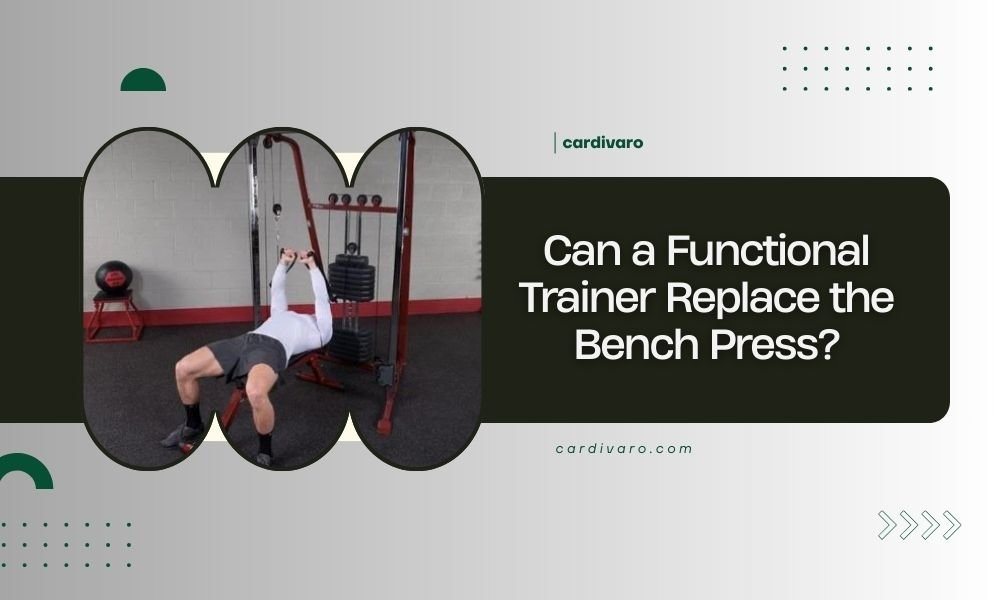
A functional trainer can replace the bench press for many people, offering similar chest muscle development with added versatility and safety features.
The functional trainer provides adjustable cable resistance that targets the same primary muscles as bench press while allowing for multiple grip positions and movement patterns.
What Makes Functional Trainers Different From Bench Press
Think of a functional trainer as the Swiss Army knife of strength equipment. While the bench press is like a hammer – great for one specific job – the functional trainer offers dozens of exercise options in one machine.
A functional trainer uses adjustable pulleys and cable resistance instead of free weights. You can set the cables at different heights and angles to work muscles from various directions.
Primary Muscle Groups Targeted
Both exercises hit your chest muscles hard. The bench press targets your pectorals, front deltoids, and triceps. The functional trainer hits these same muscles through cable chest presses and flies.
From what I read in exercise science research, cable movements can actually provide more consistent tension throughout the entire range of motion (ACSM).
Chest Development Comparison
Your chest muscles don’t know the difference between pushing a barbell or pulling against cables. They respond to resistance and progressive overload.
Many trainers say cable chest presses feel smoother and allow for better muscle control than traditional bench pressing.
Safety Advantages of Functional Trainers
Here’s where functional trainers really shine. You’ll never get pinned under a cable like you might with a heavy barbell.
The cable system provides natural stopping points. If you can’t complete a rep, you simply let go and the weight stack returns safely.
Shoulder-Friendly Movement Patterns
Research shows that cable movements allow your shoulders to move more naturally than fixed barbell paths (NIH). This can reduce injury risk for people with shoulder issues.
You can adjust the angle and grip position instantly. Feel some discomfort? Just change your hand position or cable height.
No Spotter Required
Working out alone? No problem. Functional trainers eliminate the need for spotters entirely.
This makes them perfect for home gyms where you might not always have someone around to help.
Exercise Variety and Versatility
A bench press does one thing really well. A functional trainer does dozens of things pretty well.
You can perform chest presses, flies, rows, lat pulldowns, bicep curls, and tricep extensions all on the same machine.
Upper Body Exercises Available
- Cable chest press (high, middle, low angles)
- Cable chest flies
- Single-arm pressing movements
- Crossover chest flies
- Incline and decline pressing angles
Full Body Training Options
The functional trainer doesn’t stop at chest exercises. You can train your entire body with cable squats, lunges, wood chops, and rotation exercises.
This makes it a space-saving option for smaller home gyms where every square foot matters.
Limitations Compared to Bench Press
Let’s be honest about the downsides. Bench pressing heavy weights still has some advantages.
Free weight bench pressing allows for heavier absolute loads. If your goal is maximum strength, the barbell bench press might have a slight edge.
Progressive Overload Considerations
Adding weight is easier with barbells. You just slide on more plates. With cables, you’re limited to the weight stack increments.
Most functional trainers max out around 200-300 pounds per side. Strong lifters might outgrow this resistance.
Powerlifting and Competition Goals
If you compete in powerlifting, you need to train the actual movements you’ll perform. No getting around that.
The functional trainer won’t prepare you for the specific demands of competition bench pressing.
Space and Cost Comparison
Here’s where things get interesting for home gym owners. A complete bench press setup needs a bench, barbell, plates, and ideally a power rack.
A functional trainer replaces all of this in roughly the same footprint.
| Equipment | Space Needed | Typical Cost Range |
|---|---|---|
| Bench Press Setup | 8×8 feet | $800-2000 |
| Functional Trainer | 6×8 feet | $1200-3000 |
Home Gym Integration
From what I found online, most home gym owners prefer the versatility of functional trainers over single-purpose equipment.
You get more exercises per square foot of space, which matters in basements and garages.
Maintenance Requirements
Functional trainers need occasional cable replacement and pulley lubrication. Bench press setups are basically maintenance-free.
Cable machines have more moving parts, which means more potential points of failure over time.
Who Should Choose What
Your choice depends on your specific goals and situation.
Choose the bench press if you’re a powerlifter, want maximum strength gains, or prefer the simplicity of free weights.
Functional Trainer Is Better For
- Home gym owners with limited space
- People who work out alone regularly
- Those recovering from shoulder injuries
- Anyone wanting full-body exercise options
- Beginners who need safer equipment
Bench Press Is Better For
- Competitive powerlifters
- Advanced lifters seeking maximum loads
- People with unlimited gym access
- Those who prefer traditional training methods
Making the Switch Successfully
If you decide to replace bench pressing with cable work, start with lighter resistance than you think you need.
Cable exercises feel different. Your stabilizing muscles work harder, and the movement pattern takes adjustment.
Transition Tips
Begin with basic cable chest presses before moving to more complex movements like crossovers.
Many experts recommend starting with 70-80% of your bench press weight when switching to cables.
Programming Considerations
You can follow similar rep and set schemes as bench pressing. The same progression principles apply.
Add weight, reps, or sets gradually over time. Your muscles will respond just like they would to any other resistance.
Conclusion
A functional trainer can absolutely replace the bench press for most people’s fitness goals. You’ll get similar muscle development with added safety, versatility, and convenience.
The choice comes down to your priorities. If you want one piece of equipment that does everything reasonably well, go functional trainer. If you want to maximize pressing strength and don’t mind the limitations, stick with the bench press.
Either way, consistency matters more than equipment choice. The best exercise is the one you’ll actually do regularly.
Can you build the same chest size with a functional trainer as bench press?
Yes, research shows that cable chest exercises can produce similar muscle growth as bench pressing when using progressive overload and proper form. Your muscles respond to resistance and tension, not the specific equipment type.
How much weight should I use when switching from bench press to cable chest press?
Start with about 70-80% of your bench press weight when beginning cable chest presses. The cable system provides different resistance curves and requires more stabilization, so it will feel challenging even at lower weights.
Is a functional trainer safer than bench pressing for solo workouts?
Functional trainers are generally safer for solo training since you cannot get trapped under the weight. The cable system allows you to simply release the handles if you cannot complete a repetition, eliminating the need for a spotter.
What exercises can replace bench press on a functional trainer?
Cable chest presses at various angles, cable flies, single-arm presses, and crossover movements all effectively target the same muscles as bench press. You can adjust cable height and angle to hit upper, middle, and lower chest areas.
Do functional trainers work for advanced lifters who bench press heavy weights?
Advanced lifters may find functional trainers limiting if they bench press very heavy weights, as most cable machines max out around 200-300 pounds per side. However, the different resistance curve and stability demands can still provide effective training stimulus.