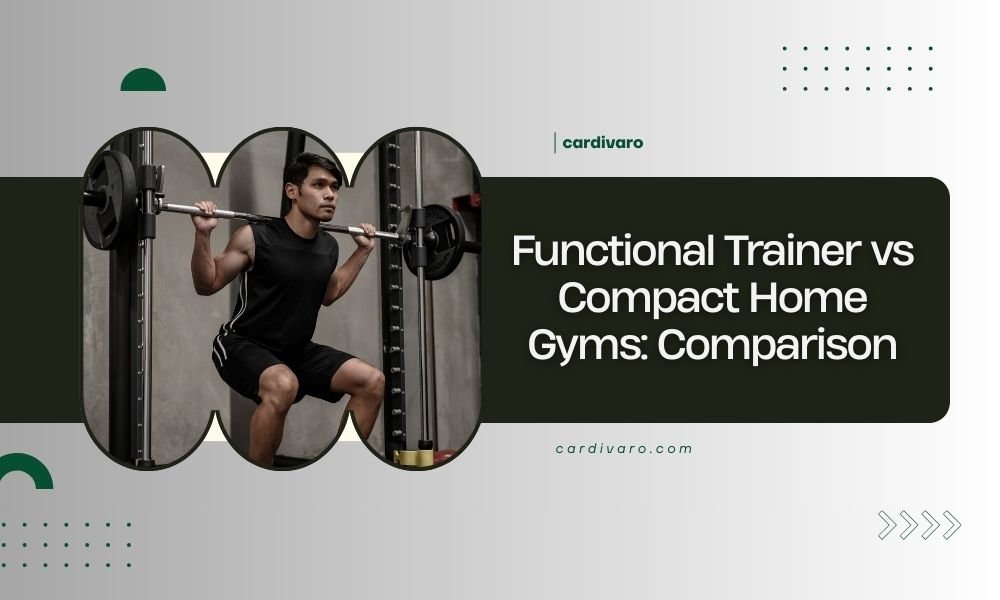
Functional trainers offer versatile cable exercises and full-body workouts, while compact home gyms provide multiple exercise options in less space with varied resistance systems.
Your choice between functional trainer vs compact home gyms depends on your workout style, space, budget, and whether you prefer cable resistance or multi-station variety.
What Makes Functional Trainers Different
Functional trainers use dual adjustable cable systems with weight stacks. You can move the cables up, down, and across your body. This mimics real-life movements like lifting, pushing, and pulling.
The cables let you work in multiple planes of motion. You’re not stuck moving weights in just one direction. This builds strength that transfers to daily activities.
Key Features of Functional Trainers
Most functional trainers share these elements:
- Dual weight stacks (usually 150-200 pounds each)
- Adjustable pulleys that move vertically
- Cable crossover capability
- Pull-up bars on top
- Various handle attachments
Space Requirements for Functional Trainers
You need about 8 feet by 6 feet of floor space. The height should be at least 7 feet. Don’t forget extra room to move around during exercises.
Understanding Compact Home Gyms
Compact home gyms pack multiple exercise stations into one machine. They might use weight stacks, resistance rods, or body weight. The goal is maximum exercises in minimum space.
These machines often combine a bench press, lat pulldown, leg extension, and rowing station. Some add resistance bands or suspension trainers.
Types of Compact Home Gym Systems
You’ll find several styles on the market:
- Multi-station weight stack systems
- Resistance rod machines
- Body weight suspension systems
- Hybrid cable and weight systems
How Much Space Do They Need
Most compact gyms fit in 6 feet by 4 feet. Some fold up when not in use. Height varies from 6 to 8 feet depending on the model.
Exercise Variety Comparison
Functional trainers excel at movement-based exercises. You can do squats with resistance, wood chops, and rotational movements. The cables follow your natural motion patterns.
Compact home gyms focus more on traditional strength training. Think bench press, lat pulldowns, and leg curls. Some models add functional movements through attachments.
Upper Body Exercise Options
With functional trainers, you get chest flyes, rows, and overhead presses from any angle. The cables adjust to your height and range of motion.
Compact gyms usually offer fixed-path exercises. The lat pulldown station only does lat pulldowns. The chest press station handles pressing movements.
Lower Body Training Differences
Functional trainers let you add resistance to squats, lunges, and step-ups. You can work one leg at a time or both together.
Many compact gyms include leg extension and leg curl attachments. Some have weight stack systems just for legs.
Cost Analysis and Value
Quality functional trainers start around $1,500 and go up to $4,000. You’re paying for smooth cable systems and heavy weight stacks.
Compact home gyms range from $500 to $2,500. The price depends on features, build quality, and resistance type.
Long-Term Investment Considerations
Functional trainers need cable replacements over time. The pulleys might need lubrication. Weight stacks are pretty much maintenance-free.
Compact gyms with resistance rods might need rod replacements. Multi-station machines have more moving parts that could wear out.
Warranty and Support Differences
I found that functional trainers often come with 5-10 year warranties on frames. The cables and pulleys get 1-2 years coverage.
Compact gym warranties vary widely. Basic models might get 90 days. Premium units could have 3-5 year protection.
Space and Setup Requirements
Setting up a functional trainer takes 2-4 hours with two people. The weight stacks are heavy. You might need help getting it in your house.
Most compact gyms assemble faster. Simpler models take 1-2 hours. The parts are usually lighter and easier to handle.
Room Layout Considerations
Functional trainers work best in the center of a room. You need access from multiple sides for the full range of exercises.
Compact gyms can sit against a wall. Some models fold up to save space when not in use.
User Experience and Workout Quality
Research shows that functional training improves daily movement patterns better than isolated exercises (American Council on Exercise). The cables feel smooth and natural.
Compact gyms give you that traditional gym feeling at home. The exercises feel familiar if you’ve used commercial equipment before.
Learning Curve Differences
Functional trainers take some getting used to. You need to learn proper cable positioning and movement patterns. This might feel awkward at first.
Compact gyms are more straightforward. If you know how to do a lat pulldown or bench press, you can jump right in.
Safety Considerations
Cables can snap if overloaded or worn out. Always check them before workouts. Keep fingers away from pulleys during exercises.
Multi-station gyms have pinch points where weight stacks meet. Make sure weight pins are secure before starting.
Who Should Choose Which Option
Pick a functional trainer if you want athletic training, rehabilitation exercises, or sport-specific movements. They’re great for people who play recreational sports.
Choose compact home gyms if you prefer traditional bodybuilding workouts, have limited space, or want multiple family members to use different stations.
| Factor | Functional Trainer | Compact Home Gym |
|---|---|---|
| Best For | Athletic training, functional movement | Traditional strength training |
| Space Needed | 8′ x 6′ minimum | 6′ x 4′ typical |
| Price Range | $1,500 – $4,000 | $500 – $2,500 |
| Exercise Variety | High (unlimited angles) | Medium (fixed stations) |
Conclusion
Your decision between functional trainers and compact home gyms comes down to how you like to work out. Functional trainers win for movement variety and athletic training. Compact home gyms excel at traditional strength exercises in tight spaces.
Both options beat paying for a gym membership long-term. Consider your space, budget, and workout goals. Either choice will serve you well if it matches your training style.
Can I build muscle effectively with either option?
Yes, both functional trainers and compact home gyms provide enough resistance for muscle building. The key is progressive overload – gradually increasing weight, reps, or difficulty over time. Most quality machines offer sufficient resistance for intermediate to advanced users.
Which option works better for beginners?
Compact home gyms often work better for beginners because the exercises are more straightforward and familiar. The guided motion paths help with proper form. Functional trainers require more coordination and movement awareness that develops over time.
How much maintenance do these machines require?
Functional trainers need cable inspections every few months and occasional pulley lubrication. Compact home gyms with weight stacks need minimal maintenance, while resistance rod systems may require rod replacements annually with heavy use.
Can multiple people use these machines effectively?
Both work for multiple users, but compact home gyms have an advantage. Different family members can use separate stations simultaneously. Functional trainers work better for one person at a time, though cable adjustments make them suitable for various heights and fitness levels.
Which option holds its value better for resale?
Quality functional trainers from reputable brands tend to hold value better because they have fewer complex parts and appeal to serious fitness enthusiasts. Compact home gyms depreciate faster, especially lower-end models with multiple moving parts that may break down.