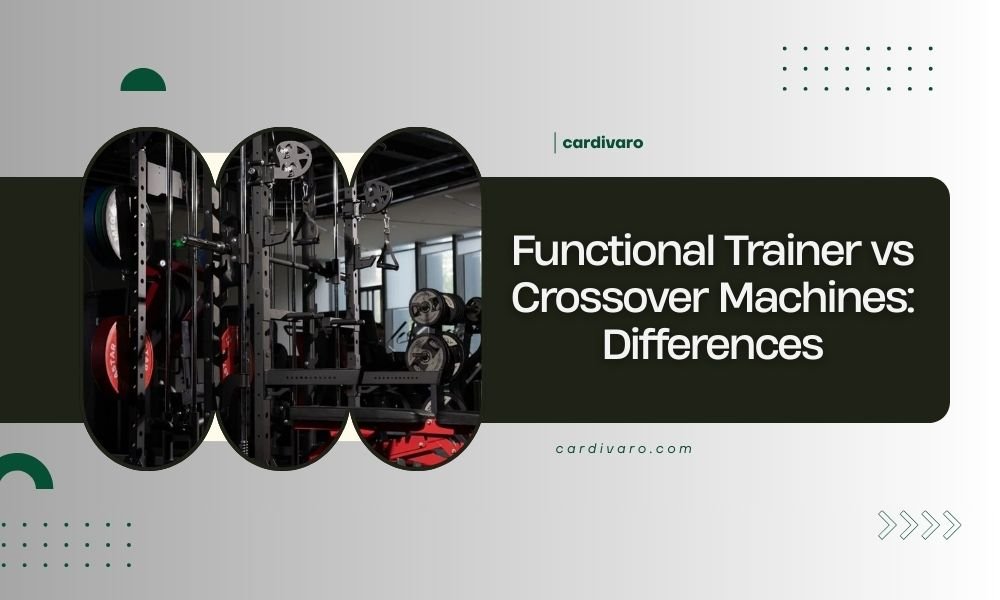
Functional trainers and crossover machines are both cable-based gym equipment, but functional trainers offer adjustable pulleys at multiple heights while crossover machines typically feature fixed high pulleys.
The main difference lies in versatility: functional trainers provide full-body workout options with their adjustable cable systems, whereas crossover machines excel primarily at upper body and pulling exercises.
What Are Functional Trainers?
Think of functional trainers as the Swiss Army knife of cable machines. They feature dual weight stacks with pulleys that adjust from floor level to overhead positions.
You can perform squats, rows, chest presses, and rotational movements all on one machine. The cables move independently, letting each arm work separately or together.
Key Features of Functional Trainers
- Adjustable pulleys (usually 19+ positions)
- Dual weight stacks (often 150-200 lbs each)
- Independent cable movement
- Multiple attachment points
- Compact footprint for home gyms
What Are Crossover Machines?
Crossover machines are the tall, imposing cable stations you see in commercial gyms. They feature high pulleys on either side with a wide cable span between them.
These machines shine for cable crossovers, lat pulldowns, and tricep pushdowns. The high pulley position makes them perfect for pulling movements.
Key Features of Crossover Machines
- Fixed high pulleys (typically 7-8 feet high)
- Wide cable span (often 8-12 feet)
- Heavy-duty construction
- Single or dual weight stacks
- Pull-up bars often included
Exercise Variety Comparison
Here’s where the rubber meets the road. What can you actually do with each machine?
Functional Trainer Exercise Options
Functional trainers win the versatility contest hands down. You can target every muscle group from multiple angles.
Upper Body Exercises
- Chest presses and flyes
- Seated and standing rows
- Shoulder presses and lateral raises
- Bicep curls and tricep extensions
Lower Body Exercises
- Cable squats and lunges
- Glute kickbacks and hip abductions
- Calf raises
- Leg curls and extensions
Core and Functional Movements
- Wood chops and rotational training
- Cable crunches
- Pallof presses
- Anti-rotation exercises
Crossover Machine Exercise Options
Crossover machines excel at specific movement patterns but offer fewer total exercise options.
Primary Exercises
- Cable crossovers (the signature move)
- High-to-low cable movements
- Lat pulldowns with attachments
- Tricep pushdowns
- Face pulls
Space and Setup Requirements
Your available space might make this decision for you. Let’s break down what each machine needs.
Functional Trainer Space Needs
Most functional trainers fit in a 6×8 foot area. That’s smaller than many people expect.
You’ll need about 3 feet of clearance around the machine for comfortable movement. The compact design makes them perfect for home gyms.
Crossover Machine Space Needs
Crossover machines demand serious real estate. Plan for at least 12×8 feet of floor space.
The wide cable span means you need room to move laterally. These machines work best in larger home gyms or commercial spaces.
Weight Capacity and Resistance
Both machines offer plenty of resistance for most users, but there are differences.
Functional Trainer Resistance
Most functional trainers offer 150-200 pounds per weight stack. That’s 300-400 pounds total resistance.
The 2:1 or 1:1 pulley ratio affects how the weight feels. A 2:1 ratio means 100 pounds feels like 50 pounds of resistance.
Crossover Machine Resistance
Crossover machines often feature heavier weight stacks, sometimes 250+ pounds per side.
The direct cable routing typically provides a 1:1 weight ratio. What you select is what you lift.
Price Comparison
Money talks, and these machines speak different financial languages.
Functional Trainer Costs
Quality functional trainers range from $2,000 to $6,000 for home models. Commercial-grade units can reach $8,000+.
You get more exercise variety per dollar spent. That makes them efficient investments for home gyms.
Crossover Machine Costs
Crossover machines typically cost $3,000 to $10,000+ depending on features and build quality.
The higher price reflects the heavy-duty construction and larger footprint. They’re built to last in commercial settings.
Which Machine Is Right for You?
The best choice depends on your specific needs and situation.
Choose a Functional Trainer If You
- Want maximum exercise variety
- Have limited space
- Train alone most of the time
- Focus on functional movement patterns
- Want better value per exercise option
Choose a Crossover Machine If You
- Have plenty of space
- Love cable crossover exercises
- Want maximum resistance capacity
- Train with partners frequently
- Prefer traditional gym equipment feel
Maintenance and Durability
Both machines require regular maintenance, but crossover machines typically last longer in heavy-use environments.
Research from fitness equipment manufacturers shows that proper cable lubrication and pulley inspection every 3-6 months prevents most issues.
Common Maintenance Tasks
- Cable inspection and replacement
- Pulley bearing lubrication
- Weight stack alignment checks
- Pin and selector rod cleaning
Conclusion
Both functional trainers and crossover machines offer excellent cable-based training, but they serve different purposes. Functional trainers provide unmatched versatility in a compact package, making them perfect for home gyms and varied workout routines. Crossover machines excel at specific exercises and offer a traditional gym experience with maximum resistance capacity.
Your choice should depend on your space, budget, and training goals. If you want the most bang for your buck with limited space, go functional trainer. If you have room and want that classic cable crossover feel, choose the crossover machine. Either way, you’ll have years of effective strength training ahead.
Can I do the same exercises on both machines?
While there’s some overlap, functional trainers offer more exercise variety due to their adjustable pulley heights. Crossover machines excel at high-pulley exercises but can’t replicate low-pulley movements effectively.
Which machine is better for beginners?
Functional trainers are typically more beginner-friendly because they allow for easier exercise progression and offer more guidance through their range of motion. The adjustable pulleys let you start with comfortable positions and progress gradually.
Do I need different attachments for each machine?
Most cable attachments work with both machines, but functional trainers often come with more attachment variety included. You might need to purchase additional attachments separately for crossover machines.
Which machine holds its value better for resale?
High-quality crossover machines typically retain value better due to their commercial-grade construction and recognizable gym appearance. Functional trainers may depreciate faster but offer better initial value through exercise variety.
Can these machines replace free weights completely?
Both machines provide excellent resistance training, but they can’t completely replace free weights for certain exercises like heavy squats or deadlifts. They work best as part of a complete home gym setup rather than standalone solutions.