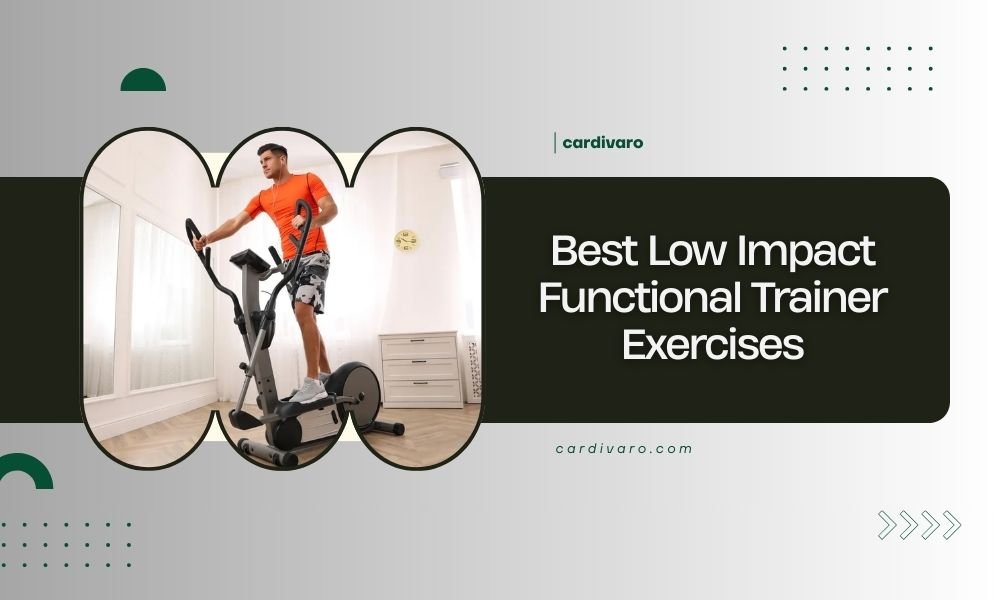
The best low impact functional trainer exercises include cable squats, seated rows, chest presses, and lat pulldowns that protect your joints while building strength.
These exercises work multiple muscle groups simultaneously using controlled resistance, making them perfect for people with joint concerns or those recovering from injury.
Why Low Impact Functional Training Matters
Your joints take a beating from high-impact activities like running and jumping. Low impact functional trainer exercises give you all the strength benefits without the joint stress.
Think of it like this: you’re getting a full workout while your knees, hips, and spine stay happy. Research shows that low impact resistance training can build muscle just as effectively as high impact methods (American Council on Exercise).
Upper Body Low Impact Exercises
Seated Cable Chest Press
This exercise targets your chest, shoulders, and triceps while keeping your spine supported. Sit with your back against the pad and press the handles forward at chest level.
Keep your core tight and move slowly. You’ll get better muscle activation with controlled movements than fast, jerky motions.
Proper Form Tips
- Keep your shoulder blades pulled back
- Don’t let your shoulders roll forward
- Press out and slightly up, not straight across
- Take 2 seconds to press, 2 seconds to return
Seated Cable Row
Your back muscles need attention, especially if you sit at a desk all day. The seated cable row strengthens your rhomboids, middle traps, and rear delts.
Pull the handle to your lower chest, not your stomach. Squeeze your shoulder blades together like you’re trying to hold a pencil between them.
Common Mistakes to Avoid
- Don’t lean back as you pull
- Keep your chest up throughout the movement
- Don’t let the weight stack slam down
Cable Lat Pulldown
Can’t do pull-ups yet? No problem. The lat pulldown builds the same muscles with adjustable resistance.
Pull the bar down to your upper chest, not behind your neck. Many people make the mistake of pulling too low or leaning back too much.
Lower Body Low Impact Exercises
Cable Squats
Regular squats can be tough on your knees. Cable squats let you control the resistance and get help on the way up.
Hold the cable handles at chest level and squat down like you’re sitting in a chair. The cables provide balance and support.
Setup Instructions
- Set the cable height to chest level
- Stand arm’s length from the machine
- Keep tension in the cables throughout
- Squat down until your thighs are parallel to the floor
Cable Step-Ups
Step-ups work your glutes and quads while improving balance. Adding cables gives you upper body work at the same time.
Step up onto a stable platform while holding the cable handles. Focus on using your leg muscles, not momentum.
Safety Considerations
- Use a platform that’s knee height or lower
- Step fully onto the platform
- Don’t bounce or use momentum
- Control the descent
Core Strengthening Exercises
Cable Wood Chops
Your core needs rotational strength, not just crunches. Cable wood chops work your obliques and deep core muscles.
Start with the cable high and pull it down across your body. Move like you’re chopping wood, but keep it controlled.
Technique Points
- Keep your arms straight but not locked
- Rotate from your core, not your arms
- Keep your hips facing forward
- Do both directions equally
Cable Pallof Press
This anti-rotation exercise teaches your core to resist movement. It’s like a plank but more functional.
Hold the cable handle at your chest and press it straight out. The cable tries to rotate you, but you resist.
Full Body Combination Movements
Cable Squat to Press
Why do one exercise when you can do two? This movement combines a squat with an overhead press.
Squat down while holding the cables at shoulder height. As you stand up, press the cables overhead.
Progression Options
- Start with light weight to learn the pattern
- Add weight as you get comfortable
- Try single-arm variations for more challenge
- Add a pause at the bottom of the squat
Cable Reverse Lunge with Row
This exercise hits your legs, glutes, and back muscles all at once. Step back into a lunge while pulling the cables toward you.
The timing takes practice. Lunge back and row at the same time, then return to standing while releasing the cables.
Creating Your Workout Routine
Beginner Framework
Start with 2-3 exercises per workout. Do 2-3 sets of 10-15 repetitions. Focus on learning proper form before adding weight.
I found that beginners do best when they master one exercise completely before adding new ones.
Sample Beginner Routine
- Seated cable chest press: 2 sets of 12
- Seated cable row: 2 sets of 12
- Cable squats: 2 sets of 15
Advanced Programming
Once you’re comfortable, you can do 4-6 exercises per session. Try 3-4 sets of 8-12 repetitions with heavier weight.
Research suggests that varying your rep ranges helps with both strength and muscle building (National Strength and Conditioning Association).
Equipment Settings and Safety
Proper Machine Setup
Your functional trainer needs proper adjustment for each exercise. Wrong settings can cause injury or poor results.
Check the cable height, weight selection, and attachment points before each exercise. It takes an extra minute but prevents problems.
Safety Checklist
- Inspect cables for fraying or damage
- Make sure weight pins are fully inserted
- Check that attachments are secure
- Clear the area around the machine
When to Progress
You’re ready to increase weight when you can complete all sets with 2-3 reps left in the tank. Don’t go to complete failure every set.
Progress slowly. Adding 5-10 pounds per week is plenty for most people.
| Experience Level | Sets | Reps | Weight Progression |
|---|---|---|---|
| Beginner | 2-3 | 12-15 | 5 lbs per week |
| Intermediate | 3-4 | 8-12 | 5-10 lbs per week |
| Advanced | 4-5 | 6-10 | 10-15 lbs per week |
Conclusion
Low impact functional trainer exercises give you a complete workout without beating up your joints. Start with basic movements like seated rows and cable squats, then progress to combination exercises as you get stronger.
Remember that consistency beats intensity. Doing these exercises 2-3 times per week will get you better results than occasional intense sessions. Your joints will thank you, and you’ll build real-world strength that transfers to daily activities.
What’s the difference between functional training and regular weight training?
Functional training uses movements that mimic real-life activities and work multiple muscle groups together. Regular weight training often isolates individual muscles. Functional training better prepares you for daily tasks like lifting, carrying, and climbing stairs.
How often should I do low impact functional trainer exercises?
Most people benefit from 2-3 sessions per week with at least one day of rest between workouts. This gives your muscles time to recover and grow stronger. Listen to your body and add rest days if you feel overly tired or sore.
Can I lose weight with functional trainer exercises alone?
Functional trainer exercises build muscle and burn calories, but weight loss depends mainly on creating a calorie deficit through diet and exercise combined. These exercises are excellent for building lean muscle, which boosts your metabolism and helps with long-term weight management.
Are cable exercises safer than free weights?
Cable exercises provide more controlled movement paths and consistent resistance, which can be safer for beginners or people with joint issues. The cables guide the motion and provide support throughout the entire range of movement, reducing the risk of dropping weights or losing control.
How do I know if I’m using the right weight on a functional trainer?
You should be able to complete all your planned repetitions with good form while feeling challenged on the last 2-3 reps. If you can easily do more reps than planned, increase the weight. If you can’t maintain proper form, reduce the weight.