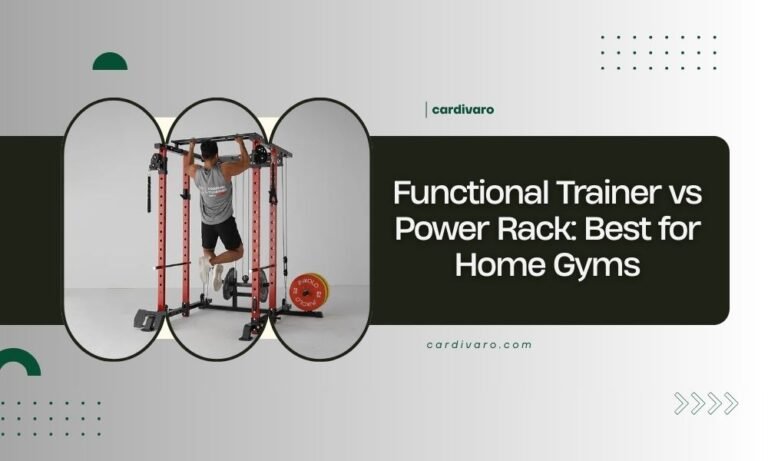
Functional trainers offer more versatility and safety features, while free weights provide better strength gains and cost less for your home gym setup.
Your choice between functional trainer vs free weights depends on your fitness goals, available space, and budget constraints.
What Is a Functional Trainer?
A functional trainer is a cable machine with adjustable pulleys on both sides. You can move these pulleys up and down to different heights. This lets you do hundreds of different exercises.
Think of it as your personal gym assistant. It guides your movements and keeps you safe while you work out.
Key Features of Functional Trainers
Most functional trainers come with weight stacks ranging from 150 to 200 pounds per side. The cables run smoothly through pulleys, giving you constant resistance.
You get multiple attachment points and various handles. Some models include pull-up bars, dip stations, and storage for accessories.
What Are Free Weights?
Free weights include dumbbells, barbells, and weight plates. They’re simple tools that have built strong bodies for over a century.
Unlike machines, free weights don’t guide your movement. Your muscles and joints control the entire motion path.
Types of Free Weight Equipment
Dumbbells come in fixed weights or adjustable sets. Barbells need weight plates that you add or remove. Kettlebells offer a unique grip and weight distribution.
You’ll also need a bench, rack, or stand for many exercises. Safety equipment like clips and collars keep weights secure.
Functional Trainer Benefits
Safety Advantages
You can’t drop weights on yourself with a functional trainer. The cables control the weight at all times. This makes them perfect for working out alone.
The smooth cable action reduces joint stress compared to free weights. Your risk of injury drops significantly.
Exercise Variety
One functional trainer replaces dozens of free weight exercises. You can work every muscle group from multiple angles.
Want to do chest flies? Just grab the handles and go. Need to work your back? Switch positions in seconds.
Space Efficiency
A functional trainer takes up about 6 by 4 feet of floor space. That’s less room than a full free weight setup with bench, rack, and storage.
Everything stays in one compact unit. No scattered weights or equipment to trip over.
Beginner Friendly
Learning proper form is easier with cables guiding your movement. New users feel more confident starting their fitness journey.
The weight adjusts in small increments. You can progress gradually without big jumps in resistance.
Free Weight Benefits
Superior Strength Gains
Research shows free weights activate more muscle fibers than machines (American Council on Exercise). Your stabilizer muscles work harder to control the weight.
This leads to faster strength and muscle gains. Your body learns to work as one connected unit.
Cost Effectiveness
A basic free weight setup costs 50-70% less than a quality functional trainer. Used weights hold their value well and last for decades.
You can start small and add weights over time. No need to buy everything at once.
Functional Movement Patterns
Free weights train your body for real-world activities. Lifting a heavy box feels easier when you’ve been deadlifting.
Your balance, coordination, and proprioception improve with free weight training.
Progressive Overload
Adding weight to a barbell is simple and precise. You can increase loads by as little as 2.5 pounds or as much as you want.
This makes long-term progression planning easier for serious strength athletes.
Functional Trainer Drawbacks
Higher Initial Cost
Quality functional trainers start around $2,000 and go up to $5,000 or more. That’s a big upfront investment for many home gym owners.
Limited Heavy Loading
Most functional trainers max out at 200 pounds per side. Advanced lifters quickly outgrow this resistance level.
You can’t do heavy compound movements like 300-pound deadlifts or squats.
Maintenance Requirements
Cables wear out and need replacement. Pulleys require lubrication. Moving parts can break down over time.
Cable Replacement Costs
Expect to replace cables every 2-3 years with regular use. Each cable costs $50-100 plus labor if you can’t do it yourself.
Free Weight Drawbacks
Safety Concerns
Dropping weights can cause injury or property damage. You need proper form to avoid hurting yourself.
Working out alone with heavy free weights requires safety equipment like power racks and spotters.
Space Requirements
A complete free weight setup needs more total space than one functional trainer. You need room to store weights safely.
Olympic barbells are 7 feet long. Make sure you have enough ceiling height and floor space.
Learning Curve
Proper free weight form takes time to master. Bad technique leads to poor results and potential injury.
New users often feel intimidated by free weights at first.
Which Option Fits Your Goals?
Choose Functional Trainers If You Want:
- Maximum safety for solo workouts
- Easy exercise variety and quick transitions
- Compact space-saving design
- Low maintenance and beginner-friendly operation
- Joint-friendly resistance training
Choose Free Weights If You Want:
- Maximum strength and muscle building potential
- Lower upfront costs and equipment flexibility
- Heavy compound movement training
- Sport-specific strength development
- Long-term durability with minimal maintenance
Cost Comparison Table
| Equipment Type | Initial Cost | Annual Maintenance | Space Needed |
|---|---|---|---|
| Functional Trainer | $2,000-5,000 | $100-200 | 24 sq ft |
| Free Weight Setup | $800-2,000 | $0-50 | 35-50 sq ft |
Can You Use Both Together?
Many serious home gym owners combine both options. Use free weights for heavy compound lifts like squats and deadlifts.
Add a functional trainer for isolation work, rehabilitation exercises, and variety. This gives you the best of both worlds.
Budget-Friendly Combination Approach
Start with basic free weights and add a functional trainer later. This spreads out your investment over time.
You can also look for used equipment to reduce costs on both options.
Conclusion
Both functional trainers and free weights have their place in home fitness. Functional trainers win on safety, convenience, and space efficiency. Free weights take the lead on strength gains, cost, and versatility.
Your best choice depends on your specific situation. Are you a beginner who values safety? Go with a functional trainer. Want maximum strength gains on a budget? Free weights are your answer.
Don’t stress too much about making the “perfect” choice. Either option will help you get stronger and healthier when you use it consistently.
What takes up less space: functional trainer or complete free weight setup?
A functional trainer typically requires about 24 square feet of floor space, while a complete free weight setup with bench, rack, and storage needs 35-50 square feet, making functional trainers more space-efficient.
How much weight can most home functional trainers handle?
Most home functional trainers have weight stacks of 150-200 pounds per side, which equals 300-400 pounds total resistance when using both cables together for exercises like chest presses.
Are functional trainers safer than free weights for beginners?
Yes, functional trainers are generally safer for beginners because the cables control the weight path and prevent dropping weights, while the smooth resistance reduces joint stress compared to free weights.
Can advanced lifters get strong enough with just a functional trainer?
Advanced lifters may find functional trainers limiting for maximum strength development since most home units cap at 200 pounds per side, which isn’t enough for heavy compound movements like deadlifts or squats.
What’s the typical lifespan difference between functional trainers and free weights?
Free weights can last 20-30 years or more with minimal maintenance, while functional trainers typically need cable replacements every 2-3 years and may require other repairs due to their moving parts and mechanical complexity.