How to Do Leg Extensions on a Cable Machine?
On this page (8 sections)
To do leg extensions on a cable machine, attach an ankle cuff to the low pulley, sit upright on a bench, and extend your legs forward against the resistance. You can also read this standing leg extension guide for another setup. This exercise effectively isolates your quadriceps for a focused muscle contraction.
Using cables instead of a traditional leg extension machine can provide a different type of tension throughout the movement. We found that this method is excellent for improving muscle stability and mind-muscle connection. Many trainers say it’s a great way to avoid momentum and keep the work right where you want it.
- Setup: Attach a single ankle cuff to the lowest cable pulley.
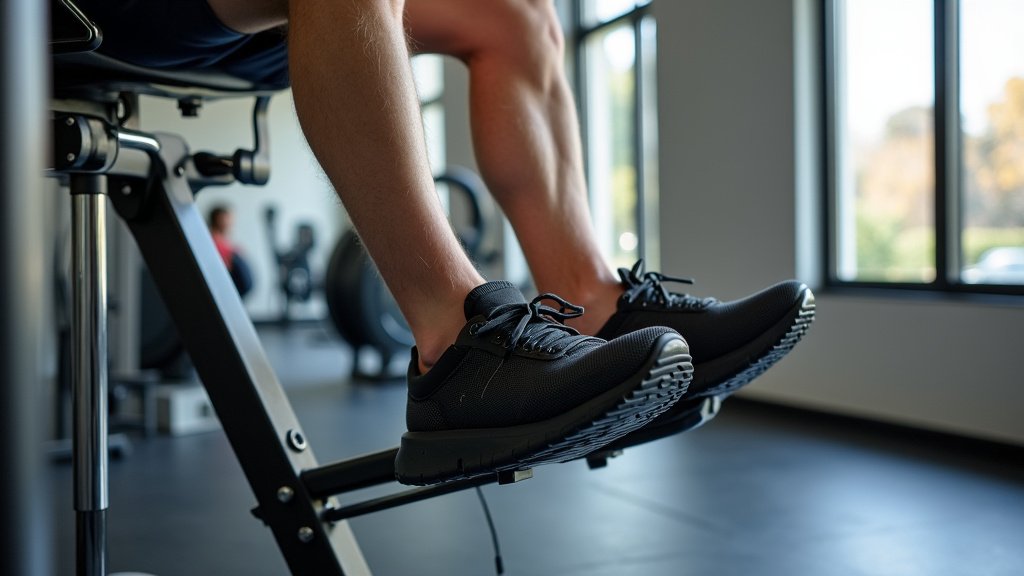
- Position: Sit sideways on a flat bench, securing the cuff around one ankle.
- Execution: Brace your core and slowly extend your leg straight out, squeezing your thigh at the top.
- Key Tip: Keep your movements slow and controlled to maximize engagement.
- Avoid: Leaning back or using your hips to swing the weight.
Below, we’ll walk through exactly how to perform this move with perfect form, along with some common mistakes to watch out for.
Why Choose the Cable for Your Leg Extensions?
Traditional leg extension machines are gym staples, but the cable machine offers a unique and powerful alternative. For more on functional trainers with leg extensions, see this guide. Many trainers prefer this setup for a few key reasons. The constant tension from the cable forces your quadriceps to work through the entire range of motion. There’s no moment where the muscle can relax, unlike the arc on a standard machine.
We found that this constant tension is excellent for building that deep mind-muscle connection. It’s harder to use momentum when the cable is pulling directly back on your ankle. This method also challenges your stabilizer muscles more, as you have to control the path of the cable yourself. For anyone looking to refine their quad development, this is a fantastic tool.
Step-by-Step Guide: Performing Cable Leg Extensions
Let’s break down the exact process from start to finish. The goal here is controlled isolation, not just moving weight from A to B. Think of it less like kicking and more like pressing a brake pedal slowly and firmly with your entire leg. This careful approach protects your knees and maximizes quad recruitment.
You’ll need a cable machine with a low pulley and a simple ankle cuff attachment. For more on cable machine benches, see this guide. Some gyms have dedicated ankle straps; otherwise, a soft, adjustable cuff works perfectly. A flat bench is your best friend here. It gives you a stable base to sit on while keeping your torso upright and supported.
Setting Up Your Station
First, attach the ankle cuff to the low pulley. Adjust the weight to a light starting point. You should be able to do 12-15 slow, perfect reps before going heavier. Remember, we’re starting with form, not ego. The cable should be directly in line with your leg when it’s extended.
Now, position the bench about two feet away from the machine. Sit on the very end of the bench, facing sideways to the pulley. The cable should run parallel to the floor when your leg is bent at 90 degrees. If the angle feels awkward, scoot the bench slightly forward or back.
Securing Yourself in Position
Lean away from the machine and fasten the cuff snugly around your working ankle. It should be tight enough not to slip, but not so tight it cuts off circulation. Place your hands on the bench behind you for support. This helps you keep an upright chest throughout the movement.
Your non-working leg can be bent with that foot flat on the floor for stability. Brace your core as if you’re about to take a light punch to the stomach. This abdominal tension protects your lower back and keeps your torso perfectly still. Only your lower leg should be moving.
Executing the Perfect Rep
Take a breath and brace. Slowly extend your leg straight out in front of you. Imagine you are pressing your foot through a block of thick, cold gel. The motion should take a full two seconds. As your leg straightens, focus entirely on squeezing the large muscle on the front of your thigh.
At the very top of the movement, when your leg is straight, hold that squeeze for a one-count. This peak contraction is pure gold for muscle growth. Then, resist the pull of the weight as you return to the starting position over another two seconds. Never let the weight stack crash down.
Perfecting Your Form: The Non-Negotiable Details
Great form is what separates this from a pointless movement. We found that most mistakes happen because people rush or use too much weight. Your focus should be on the quality of each contraction, not the number on the stack. Let’s look at the critical details that matter most.
First, keep your thigh completely still. The only joint moving should be your knee. If your hip is flexing or your thigh is lifting off the bench, the weight is too heavy. You’re recruiting your hip flexors instead of isolating the quads. Ditch the ego and lower the weight.
Second, control the negative. The lowering phase is just as important as the lift. Many experts say that the eccentric (lowering) portion of an exercise causes significant muscle stimulation. If you just let the cable yank your leg back, you’re missing half the benefit.
Common Mistakes That Sabotage Your Results
Watch out for these three frequent errors. They creep in when you get tired or try to lift too heavy. Fixing them will instantly make the exercise more effective and safer for your joints.
Leaning Back and Swinging
This is the number one cheat. As the set gets hard, you might lean your torso back to use momentum. This turns it into a hip flexor exercise and puts unnecessary stress on your lower back. Keep your chest proud and your back straight against no backrest.
Lifting Your Butt Off the Bench
If your hips are rising as you kick out, the weight is absolutely too heavy. This is a sign you’re using your entire body to move the load. Sit firmly on the bench. If your glutes lift, that set is over.
Rushing Through the Reps
Speed kills gains on this exercise. Jerky movements use momentum and take tension off the quads. A good rule of thumb: if you can’t do a two-second lift and a two-second lower, the weight is too high.
Cable vs. Traditional Leg Extension Machine
Which one is better? It depends on your goals. The table below highlights the key differences so you can choose wisely for your training.
| Feature | Cable Machine | Traditional Machine |
|---|---|---|
| Muscle Focus | Constant tension, more stabilizer recruitment | Isolated quad focus, less stabilization needed |
| Momentum | Harder to use momentum, more strict | Easier to use momentum if form breaks |
| Variations | Can perform single-leg, multi-angle pulls | Limited to the machine’s fixed path |
| Joint Stress | Often considered more natural for the knee | Can feel stressful if not aligned perfectly |
Research published in the Journal of Strength and Conditioning Research has shown that free-motion exercises can activate muscles differently than fixed-path machines. Both have their place, but the cable offers unique benefits for control and muscle engagement.
Smart Variations and Programming
Once you’ve mastered the basic single-leg extension, you can mix things up. This prevents adaptation and keeps your muscles guessing. Here are two effective variations to try.
Standing Cable Leg Extension: Stand facing away from the machine, cuff on one ankle. Brace against a support with your hand and extend your leg straight back. This hits the quads from a different angle and challenges your balance even more.
Two-Angle Cable Extension: Perform a set of standard extensions. Then, without resting, pivot your body 45 degrees away from the machine and immediately do another set. This hits different parts of the quadriceps group for more complete development.
How Many Sets and Reps Should You Do?
For muscle growth, aim for 3-4 sets of 8-12 repetitions with a weight that challenges you in that range. Focus on the mind-muscle connection. For muscular endurance, try 2-3 sets of 15-20 reps with a lighter weight.
We found that placing this exercise at the end of a leg workout is ideal. Pre-exhausting your quads with squats or leg presses first means you can use lighter weight here and still get a deep burn. Always finish with good form, not heavy weight.
Your Pre-Flight Checklist for Perfect Form
Before you start your set, run through this quick mental checklist. Getting these right sets you up for success from the first rep.
- Ankle Cuff Position: Centered on the ankle, secure but not painful.
- Bench Placement: Far enough back that your leg is at 90 degrees when bent.
- Torso Alignment: Chest up, hands supporting you, core braced tight.
- Thigh Stability: Pressed firmly against the bench, not moving at all.
- Controlled Tempo: Committed to a slow, steady two-second lift and lower.
- Peak Contraction: Squeezing the quad hard for a full second at the top.
This exercise is a masterclass in control. By using the cable, you’re taking a simple movement and making it incredibly effective. You’re not just lifting weight; you’re teaching your quads to fire on command. That kind of control carries over to every other lift in the gym.
Start light, master the feel, and then gradually increase the load. Your knees will thank you, and your quads will respond with new growth. Now, go find a cable and a bench, and give this a try. You might just find your new favorite way to build those legs.
Conclusion
You’ve now got the complete blueprint for mastering leg extensions on the cable machine. Remember, the real magic happens in the control. You are using constant tension and strict form to build a stronger mind-muscle connection with your quadriceps. By keeping your thigh still, controlling the tempo, and squeezing at the top, you transform a simple movement into a powerful tool for growth. Don’t just chase weight on the stack; chase the perfect contraction. Start light, nail the feel, and your quads and knees will thank you. It’s time to find a bench, grab that ankle cuff, and put this perfect form into practice.
Frequently Asked Questions
Can I build big quads using only cable leg extensions?
While cable leg extensions are excellent for isolating and refining your quadriceps, they are best used as a supplement. For ideas on combining leg movements, see this cable machine leg workout. For maximal size and strength, you should pair them with compound lifts like squats and leg presses. Think of the cable extension as the detailed finishing work after you’ve built the foundation.
How often should I do cable leg extensions?
You can perform this exercise 2-3 times per week as part of your leg routine. Since it’s an isolation exercise, it’s less taxing on your nervous system. A good rule is to allow at least 48 hours between sessions targeting the same muscle group to ensure proper recovery.
What can I do if my gym doesn’t have an ankle cuff?
You can use a soft, padded weightlifting belt looped around your ankle and the cable. For more on leg extension attachment, see this guide. Alternatively, a towel wrapped around the cable handle can provide a makeshift cuff. Ensure whatever you use is secure and won’t slip during the movement to maintain safety and tension.
Is this exercise bad for my knees?
When performed correctly with controlled, moderate weight, it is generally safe for healthy knees. The key is to avoid locking out your knee violently at the top and to never use momentum. If you feel sharp pain (not muscle fatigue), stop immediately and consult a physical therapist.
Should I use a single leg or double leg attachment?
Single-leg extensions are superior for this setup. They allow you to focus on one quad at a time, correct muscle imbalances, and prevent your stronger side from compensating. It also helps you maintain better form and core engagement throughout each set.