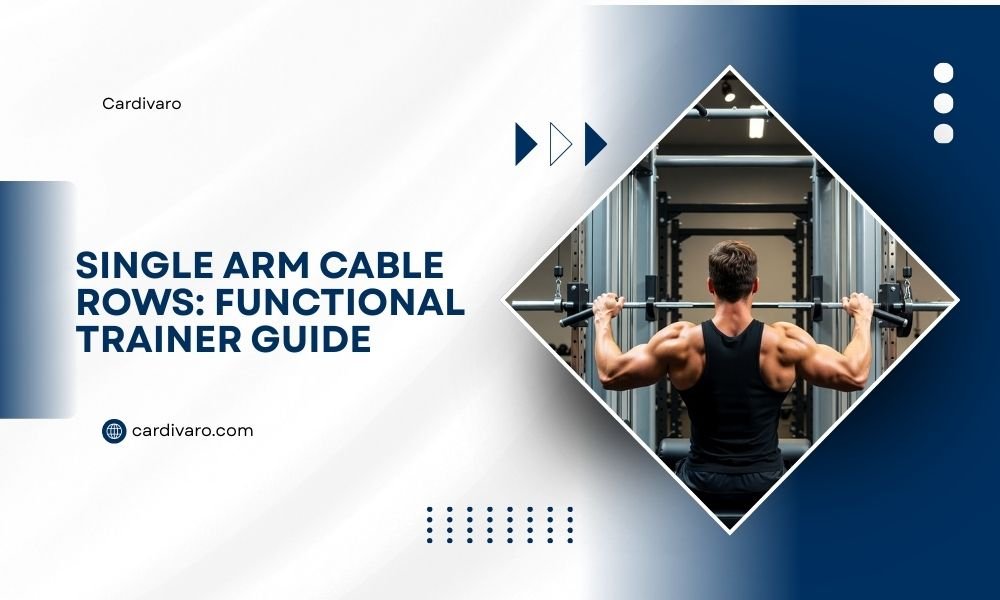
Single arm cable rows on a functional trainer build unilateral back strength while improving posture and correcting muscle imbalances between your left and right sides.
You’ll target your lats, rhomboids, and middle traps with this exercise, making it perfect for anyone wanting a stronger, more balanced back.
What Makes Single Arm Cable Rows Special
Think of single arm cable rows as the Swiss Army knife of back exercises. Unlike barbell rows where both arms work together, this movement forces each side of your body to work independently.
When you row with one arm, your core has to work overtime to keep you stable. It’s like trying to balance on a seesaw while someone throws you a medicine ball.
Why Choose Cable Over Dumbbells
Cable machines provide constant tension throughout the entire range of motion. Dumbbells rely on gravity, so you lose resistance at certain angles.
The cable system also lets you adjust the angle easily. Want to hit your upper lats? Set the cable high. Need to target your middle traps? Go for a middle position.
Setting Up Your Functional Trainer
Getting your setup right makes the difference between a great workout and a waste of time. Let me walk you through it step by step.
Cable Height Selection
For most people, chest height works best. This targets your lats and middle back evenly.
Set the cable at your sternum level when you’re standing upright. If the machine has numbered settings, this usually falls around position 4 or 5 on most functional trainers.
Handle Attachment Options
You have several handle choices, and each feels different in your hand:
- Single D-handle: Most common and comfortable for beginners
- Neutral grip handle: Reduces wrist strain during longer sets
- Fat grip attachment: Builds forearm strength while you row
- Cable without handle: Advanced option for maximum grip challenge
Weight Stack Position
Start with a weight that lets you complete 12-15 reps with perfect form. You can always add more weight once your technique is solid.
Research from the American Council on Exercise shows that proper form beats heavy weight every time for muscle development.
Perfect Single Arm Cable Row Technique
Here’s where most people go wrong: they turn this into a full-body exercise when it should be all about the back and core.
Starting Position Setup
Stand about two feet from the machine with your feet shoulder-width apart. Grab the handle with your right hand first.
Your arm should be fully extended but not locked out. Think of it like reaching across a table to grab something just out of reach.
Body Positioning Basics
Keep your chest up and shoulders back. Your free hand can rest on your hip or the machine for balance.
Lean slightly back from your ankles, not your waist. You want a straight line from your head to your heels.
The Rowing Movement
Pull your elbow straight back like you’re starting a lawnmower. Your hand should end up near your lower ribs.
Focus on squeezing your shoulder blade toward your spine. Many trainers say “imagine crushing a grape between your shoulder blades.”
Common Form Mistakes
Don’t let your shoulder roll forward at the start. This puts unnecessary stress on your shoulder joint.
Avoid twisting your torso during the pull. Your core should work to prevent rotation, not create it.
Muscle Groups You’re Training
Single arm cable rows work more muscles than you might think. It’s not just about your back.
Primary Movers
Your latissimus dorsi (lats) do most of the pulling work. These are the large V-shaped muscles that give your back its width.
The rhomboids and middle trapezius squeeze your shoulder blades together. These smaller muscles are often weak from too much sitting and computer work.
Secondary Muscles
Your posterior deltoids (rear shoulders) help with the pulling motion. Your biceps assist with elbow flexion.
Your core muscles work hard to keep you stable. Research from the Journal of Strength and Conditioning shows that single-arm exercises activate core muscles 30% more than bilateral movements.
Stabilizing Muscles
Your obliques prevent unwanted rotation. Your erector spinae keep your spine in proper alignment.
Even your legs get involved as they help maintain your base of support throughout the movement.
Programming Your Single Arm Cable Rows
How many sets and reps should you do? The answer depends on your goals and current fitness level.
Beginner Guidelines
Start with 2-3 sets of 10-12 reps per arm. Rest 60-90 seconds between sets.
Focus on learning the movement pattern before worrying about adding weight. Good form now prevents injuries later.
Intermediate Programming
Try 3-4 sets of 8-12 reps per arm. You can increase the weight when you can complete all sets with perfect form.
Consider alternating arms within the same set. Do one rep with your right arm, then immediately switch to your left.
Advanced Variations
Add a pause at the top of each rep. Hold the squeeze for 2-3 seconds before lowering the weight.
Try different tempos. Take 3 seconds to pull the weight back, pause for 1 second, then take 3 seconds to return to start.
| Experience Level | Sets | Reps per Arm | Rest Between Sets |
|---|---|---|---|
| Beginner | 2-3 | 10-12 | 60-90 seconds |
| Intermediate | 3-4 | 8-12 | 90-120 seconds |
| Advanced | 4-5 | 6-10 | 120-180 seconds |
Troubleshooting Common Issues
Even with perfect instructions, you might run into some challenges. Here are the most common problems and their solutions.
Feeling It in the Wrong Places
If your arms get tired before your back, you’re probably pulling with your biceps instead of your lats.
Try thinking about pulling your elbow back rather than pulling the handle toward you. This mental cue helps activate the right muscles.
Balance Problems
Can’t stay stable during the movement? Widen your stance or hold onto the machine with your free hand.
Some people benefit from a staggered stance with one foot slightly forward. Experiment to find what works for you.
Shoulder Discomfort
Sharp pain in your shoulder usually means you’re starting with your shoulder in a bad position.
Make sure your shoulder blade is pulled back and down before you start the rowing motion. Think “proud chest” posture.
Variations to Keep Things Fresh
Once you master the basic movement, these variations add new challenges and keep your workouts interesting.
Height Variations
High cable rows (cable above shoulder height) target your upper lats and rear delts more.
Low cable rows (cable at hip height) hit your middle and lower lats while working your core differently.
Stance Modifications
Try a split stance with your outside leg forward. This creates more of a lunge position and challenges your balance.
Single-leg stance turns this into a serious core and stability challenge. Only try this once you’ve mastered the basic version.
Tempo Changes
Slow negatives: Take 4-5 seconds to return the weight to the starting position. This builds strength in the stretched position.
Explosive pulls: Pull the weight back as fast as possible while maintaining control. This develops power and muscle fiber recruitment.
When to Add Single Arm Cable Rows
Timing matters when you’re building a workout routine. Here’s how to fit this exercise into your training schedule.
Back Day Placement
Do single arm cable rows after your main pulling exercises like pull-ups or lat pulldowns.
They work well as a finishing exercise when your back is already warmed up and you want to target any weak spots.
Full Body Workout Integration
Pair them with a pushing exercise like push-ups or overhead press. This creates a balanced upper body workout.
You can also superset with core exercises since your abs are already working during the rows.
Safety Tips and Precautions
While single arm cable rows are generally safe, a few precautions keep you injury-free.
Warm-Up Requirements
Always warm up your shoulders and upper back before starting. Arm circles and band pull-aparts work well.
Do a few light sets with minimal weight to prepare your muscles and joints for the working sets.
When to Stop
Stop immediately if you feel sharp pain in your shoulder, elbow, or lower back.
Muscle fatigue is normal and expected. Joint pain is not. Listen to your body and don’t push through actual pain.
Conclusion
Single arm cable rows give you a complete back workout while building the kind of functional strength that transfers to everyday activities. The unilateral nature fixes muscle imbalances and forces your core to work harder than bilateral exercises.
Start with lighter weight and focus on perfect form. As you get stronger, you can add weight, change angles, or try advanced variations. Remember that consistency beats intensity every time when it comes to building a strong, healthy back.
Your posture will improve, your back will get stronger, and you’ll develop the kind of functional fitness that makes daily tasks easier. That’s what good training should do.
How often should I do single arm cable rows each week?
Two to three times per week works well for most people, allowing at least 48 hours of rest between sessions. You can do them more frequently if you vary the intensity and volume.
Should I do the same number of reps for both arms?
Always start with your weaker arm and match that number with your stronger arm. This prevents the strength gap from getting bigger over time.
Can I do single arm cable rows if I have lower back problems?
Check with your doctor first, but many people with back issues find single arm rows easier than bent-over rows since you maintain a more upright position and have better control.
What’s the difference between using a rope attachment versus a handle?
Rope attachments allow for a neutral wrist position and work your grip strength more, while handles provide a more secure grip that lets you focus purely on back muscle activation.
How do I know if I’m using the right amount of weight?
You should be able to complete all reps with perfect form while feeling challenged on the last 2-3 reps of each set. If your form breaks down, reduce the weight.