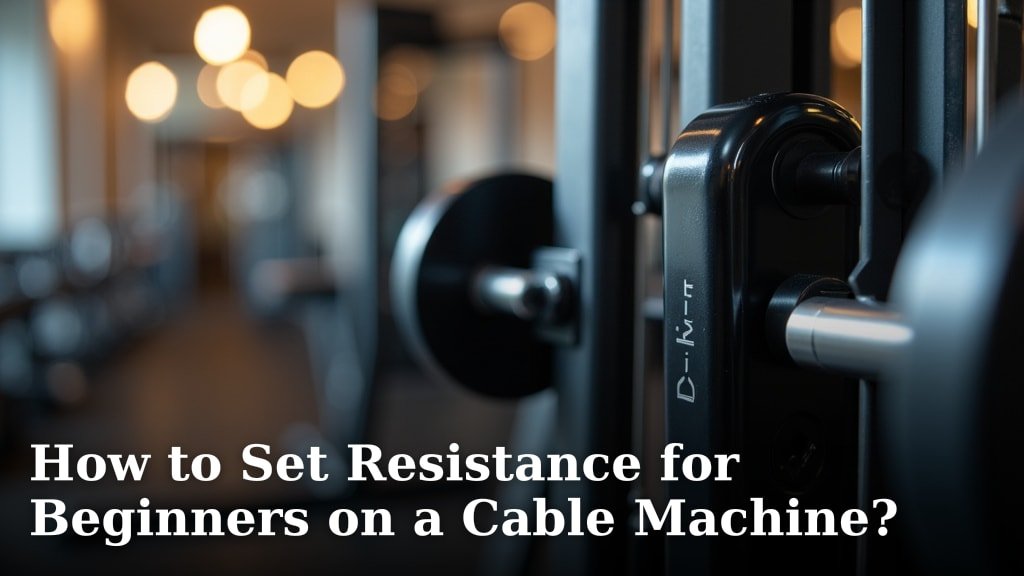
To set resistance for beginners on a cable machine, start with the lowest weight possible. Most cable machines have a weight stack with a pin; simply insert the pin into the lightest plate. This allows you to focus on proper form without straining your muscles.
You want to pick a weight where you can comfortably complete 10-15 repetitions with good control. We found that beginners often overestimate their strength, leading to injury. Remember, the goal is to build a solid foundation, not lift the heaviest weight right away.
- Start with the absolute lightest weight.
- Focus on learning correct movement patterns.
- Aim for 10-15 controlled repetitions.
- Increase weight only when form is perfect.
- Prioritize safety and muscle engagement.
Let’s walk through exactly how to choose the right resistance and get the most out of your cable machine workouts, step by step. For those looking to integrate this into a broader plan, our guide on what is a good beginner cable machine workout routine offers comprehensive advice.
Mastering Your Cable Machine Resistance for Optimal Results
Setting the right resistance on a cable machine is essential for beginners. It helps you build strength safely and effectively.
Understanding the Cable Machine Weight Stack
The weight stack is the heart of your cable machine’s resistance system. It’s usually a tower of metal plates.
You’ll see a pin attached by a cord. This pin is how you select your desired weight. Insert it into a hole in the weight stack.
Most machines have the weight values clearly marked on each plate. Start by finding the very top plate, which represents the lightest resistance.
Pin Placement and Weight Selection
For beginners, your first step is always to locate the lowest weight option. This usually means placing the pin at the very top of the stack.
Sometimes, machines might have an additional small, lighter plate at the top. This is often an “add-on” weight for micro-adjustments. Use it!
Don’t be shy about starting light. We found that beginning with a weight you can truly control prevents bad habits from forming (American Council on Exercise).
The Importance of Repetition Range and Form
Your goal isn’t just to move the weight. It’s to move the weight correctly, feeling the right muscles work.
For beginners, a repetition range of 10-15 repetitions per set is often recommended. This range helps build muscle endurance and promotes good form.
If you can do more than 15 reps easily, the weight is too light. If you struggle to complete 8-10 reps with good form, the weight is too heavy.
What Does “Good Form” Really Mean?
Good form means your body moves in a controlled, fluid way. You should feel the target muscle contracting and relaxing.
Avoid jerking motions or using momentum. The movement should be slow and deliberate, especially during the lowering phase of the exercise.
Many experts say watching yourself in a mirror can be helpful to check your form. Are your joints aligned? Is your spine neutral?
How to Test and Adjust Your Resistance
You won’t always pick the perfect weight on your first try. That’s totally fine! Testing is part of the process.
Perform a few repetitions with your chosen weight. Pay close attention to how your body feels. Is it too easy? Too hard?
Adjust the pin up or down the weight stack as needed. It’s better to make small adjustments than big leaps.
When to Increase Resistance
You should increase your resistance when you can comfortably complete 15 repetitions with perfect form for two consecutive sets.
A small increase, like moving the pin down one slot, is usually enough. Don’t add too much weight at once.
This progressive overload principle is how your muscles get stronger over time (National Strength and Conditioning Association). Understanding this principle is key to knowing how you can build muscle with a cable machine over time.
When to Decrease Resistance
If your form starts to break down, or you can’t complete at least 10 repetitions, your weight is too heavy. Decrease it immediately.
It’s okay to go down in weight. This shows you’re listening to your body and prioritizing safety over ego.
Remember, consistent, proper movement at a lighter weight is far more beneficial than struggling with a heavy weight and risking injury.
Common Cable Machine Exercises for Beginners
Cable machines are versatile. They can work almost every muscle group. Here are a few exercises often recommended for beginners:
| Exercise | Muscles Worked | Tips for Beginners |
|---|---|---|
| Cable Row | Back (lats, rhomboids) | Keep your back straight, pull with your elbows. |
| Cable Press | Chest (pectorals), shoulders | Stand tall, press straight out, control the return. |
| Cable Bicep Curl | Biceps | Keep elbows tucked, focus on squeezing the bicep. |
| Cable Triceps Pushdown | Triceps | Keep elbows close to your sides, extend fully. |
| Cable Wood Chop | Core (obliques) | Rotate through your torso, keep core tight. |
This table gives you a starting point. There are many variations to learn as you progress.
Safety First: Pre-Workout Checklist
Before you even touch the cable machine, a quick check can prevent problems. Think of it as your pre-flight routine.
We found that many gym injuries are preventable with basic precautions.
- Check the cable for any fraying or damage.
- Ensure the pin is fully inserted into the weight stack.
- Make sure the attachment (handle, rope) is securely fastened.
- Clear the area around the machine; avoid tripping hazards.
- Do a quick dynamic warm-up before your first set.
These simple steps help ensure your workout is both effective and safe.
Listen to Your Body and Be Patient
Progress isn’t always linear. Some days you might feel stronger, other days not so much. That’s normal.
If you feel any sharp pain, stop immediately. Pushing through pain is never a good idea. Consult a professional if pain persists.
Building strength takes time and consistency. Celebrate small victories and focus on continuous improvement, not perfection.
Remember why you started. You’re building a stronger, healthier you, one controlled repetition at a time.
Conclusion
You now have the tools to confidently approach the cable machine as a beginner. Remember, starting with the lightest resistance allows you to master proper form. This foundation prevents injury and ensures you’re targeting the right muscles effectively.
Listen to your body, make small adjustments, and celebrate your progress. We found that consistency and patience are far more important than lifting heavy weights too soon. Go ahead, apply these steps, and enjoy building a stronger you with your cable machine workouts.
Frequently Asked Questions
What if the lowest weight on a cable machine is still too heavy for me?
If the absolute lowest weight is challenging, you can try reducing the range of motion for an exercise or using a spotter for assistance. You might also look for machines with smaller weight increments or resistance bands to build initial strength before moving to the cable machine.
How often should I adjust the resistance on a cable machine as a beginner?
You should only increase resistance once you can comfortably complete 15 repetitions with perfect form for two consecutive sets. This might mean adjusting every few workouts, or it could take longer. Progress isn’t always linear, so be patient and focus on consistency.
Can I use resistance bands with a cable machine if the weights are too much?
Yes, in some cases, you can attach resistance bands to a cable machine’s handles or anchor points to add a different type of resistance or make an exercise easier. This can be a great way to bridge the gap if the machine’s lowest weight is still too heavy for you.
Is it okay to use different resistance levels for different exercises on the same day?
Absolutely! Different exercises target different muscle groups, and some muscles are naturally stronger than others. You might use a higher resistance for a cable row and a much lower resistance for a triceps pushdown, for example. Always choose the resistance that allows for good form on that specific exercise.
What’s the difference between pin-loaded and plate-loaded cable machines for beginners?
Pin-loaded machines use a stack of plates with a pin for selection, which is usually easier and quicker for beginners to adjust. Plate-loaded machines require you to manually add or remove weight plates, which can sometimes be more cumbersome and less common for general cable machines.