Functional trainers offer more exercise variety and better build quality than most Bowflex machines, but Bowflex models typically cost less and take up less space in your home gym.
The choice between functional trainer vs Bowflex depends on your budget, available space, and whether you prioritize exercise variety or compact convenience.
What Is a Functional Trainer?
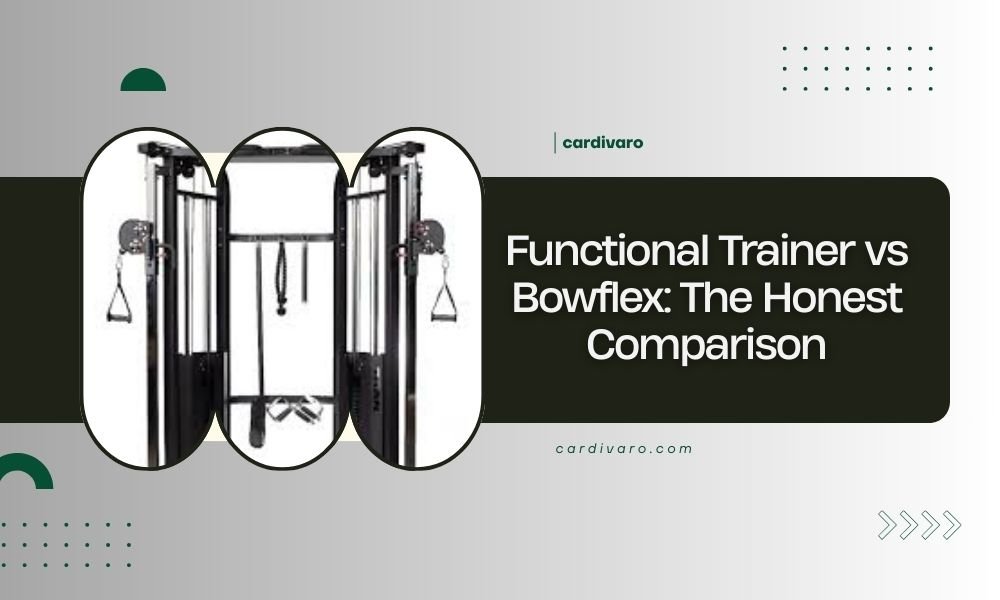
A functional trainer uses two adjustable cable columns with weight stacks. You can move the pulleys up and down to target different muscle groups.
These machines let you do hundreds of exercises. Think cable crossovers, lat pulldowns, rows, and squats. The cables move in natural patterns that match how your body works in real life.
Key Features of Functional Trainers
- Dual weight stacks (usually 150-200 pounds each)
- Adjustable pulley heights
- Multiple attachment points
- Wide variety of handle attachments
- Sturdy steel construction
What Is Bowflex Equipment?
Bowflex makes home gym equipment using different resistance systems. Some use flexible rods called Power Rods. Others use weight plates or resistance bands.
Popular Bowflex models include the PR3000, Revolution, and HVT systems. Each targets different user needs and budgets.
Types of Bowflex Systems
Power Rod Systems
These bend flexible rods to create resistance. The PR1000 and PR3000 are common examples. They’re compact but limit your exercise options.
SelectTech Systems
Bowflex SelectTech dumbbells adjust weight with a dial system. They save space but don’t offer the same cable-based movements as functional trainers.
HVT and Revolution Models
These higher-end Bowflex machines use different resistance methods. The Revolution uses Spiraflex technology instead of traditional weights.
Exercise Variety Comparison
Functional trainers win this category hands down. You can perform over 200 exercises on most models.
Bowflex machines typically offer 30-100 exercises depending on the model. The Power Rod systems are the most limited.
Functional Trainer Exercise Options
- Upper body: chest flies, rows, pulldowns, tricep extensions
- Lower body: squats, lunges, leg curls, hip abductions
- Core: wood chops, cable crunches, rotational movements
- Full body: functional movements like lifting and carrying patterns
Bowflex Exercise Limitations
Power Rod systems work well for basic strength training. But they can’t match the movement freedom of cables.
You’re stuck with the machine’s predetermined paths. This limits functional movement patterns that help with daily activities.
Build Quality and Durability
Most functional trainers use heavy-duty steel frames. Commercial-grade models can handle years of heavy use.
Bowflex quality varies by model. Higher-end units are solid, but entry-level models sometimes feel flimsy.
Weight Stack vs Power Rod Durability
Weight stacks last decades with proper care. Power Rods can break after heavy use, and replacements cost extra.
I found that many fitness experts prefer weight-based systems for long-term reliability.
Space Requirements
Here’s where Bowflex often wins. Most models are more compact than functional trainers.
| Machine Type | Typical Footprint | Height Needed |
|---|---|---|
| Functional Trainer | 8′ x 6′ | 8-9 feet |
| Bowflex PR Series | 8′ x 4′ | 6.5-7 feet |
| Bowflex Revolution | 8′ x 6′ | 8.5 feet |
Storage Considerations
Some Bowflex models fold for storage. Functional trainers stay put once you set them up.
Do you have a dedicated gym room? Go with either option. Working out in a multi-use space? Bowflex might work better.
Cost Comparison
Entry-level Bowflex machines start around $400-800. Basic functional trainers begin around $1,000-1,500.
High-end models flip this script. Premium Bowflex machines can cost $3,000+, while quality functional trainers range from $1,500-4,000.
Value for Money Analysis
Functional trainers give you more exercises per dollar spent. But Bowflex wins if you need the lowest upfront cost.
Think about cost per exercise. A $1,500 functional trainer with 200+ exercises costs about $7.50 per exercise. A $600 Bowflex with 60 exercises costs $10 per exercise.
Ease of Use
Bowflex machines are beginner-friendly. Most exercises follow simple movement patterns.
Functional trainers offer more options but need more learning. You’ll spend time figuring out different handle attachments and pulley positions.
Setup and Assembly
Both require assembly, but functional trainers take longer. Plan on 3-6 hours for most models.
Bowflex machines typically assemble in 2-4 hours. The instructions are usually clearer too.
Maintenance Requirements
Functional trainers need regular cable and pulley maintenance. Check for fraying cables every few months.
Bowflex Power Rod systems need less maintenance. Just keep the rods clean and check for cracks.
Long-term Maintenance Costs
Replacement cables cost $20-50 each. Power Rods run $30-80 per rod when they break.
Weight stacks rarely need replacement. Power Rods break more often with heavy use.
Who Should Choose a Functional Trainer?
Pick a functional trainer if you want maximum exercise variety. They’re perfect for people who get bored easily.
Athletes and fitness enthusiasts love the natural movement patterns. Physical therapists often recommend them for rehabilitation work.
Ideal Functional Trainer User
- Has a dedicated gym space
- Wants 200+ exercise options
- Values build quality and durability
- Willing to learn proper cable techniques
- Budget allows $1,500+ investment
Who Should Choose Bowflex?
Choose Bowflex if space and budget are your main concerns. They’re great for basic strength training.
Beginners often prefer the guided movement patterns. You can’t go wrong with most exercises.
Ideal Bowflex User
- Limited space or shared workout area
- Needs lower upfront investment
- Prefers simple, guided movements
- Focuses on basic strength training
- Values compact storage options
Safety Considerations
Both systems are generally safe when used properly. Functional trainers need more attention to form.
Bowflex machines guide your movements, reducing injury risk. But this same guidance limits functional movement patterns.
Common Safety Issues
Watch for cable snap on functional trainers. Inspect cables regularly and replace when worn.
Power Rods can break suddenly. This rarely causes injury but stops your workout immediately.
Conclusion
The functional trainer vs Bowflex debate comes down to your priorities. Functional trainers offer superior exercise variety, better build quality, and more natural movements. They’re the clear choice if you have the space and budget.
Bowflex machines work well for basic strength training in limited spaces. They cost less upfront and are easier for beginners to use.
Consider your long-term fitness goals. Will you get bored with limited exercises? Do you have room for a larger machine? Answer these questions honestly, and your choice becomes clear.
What’s the main difference between functional trainers and Bowflex machines?
Functional trainers use adjustable cable systems with weight stacks, offering 200+ exercises. Bowflex machines typically use Power Rod resistance or other systems, providing 30-100 exercises with more guided movements.
Which is better for small spaces?
Bowflex machines are generally more compact, with some models offering folding storage options. Most functional trainers require dedicated space and can’t be easily moved or stored.
How much should I budget for each option?
Entry-level Bowflex machines start around $400-800, while basic functional trainers begin at $1,000-1,500. High-end models of both types can reach $3,000-4,000.
Which provides better workout variety?
Functional trainers offer significantly more exercise options due to their adjustable cable system. You can perform compound movements, isolation exercises, and functional movement patterns that Bowflex machines can’t match.
Are functional trainers harder to learn than Bowflex machines?
Yes, functional trainers have a steeper learning curve. You’ll need to learn proper cable techniques, pulley positions, and various handle attachments. Bowflex machines provide more guided, beginner-friendly movements.