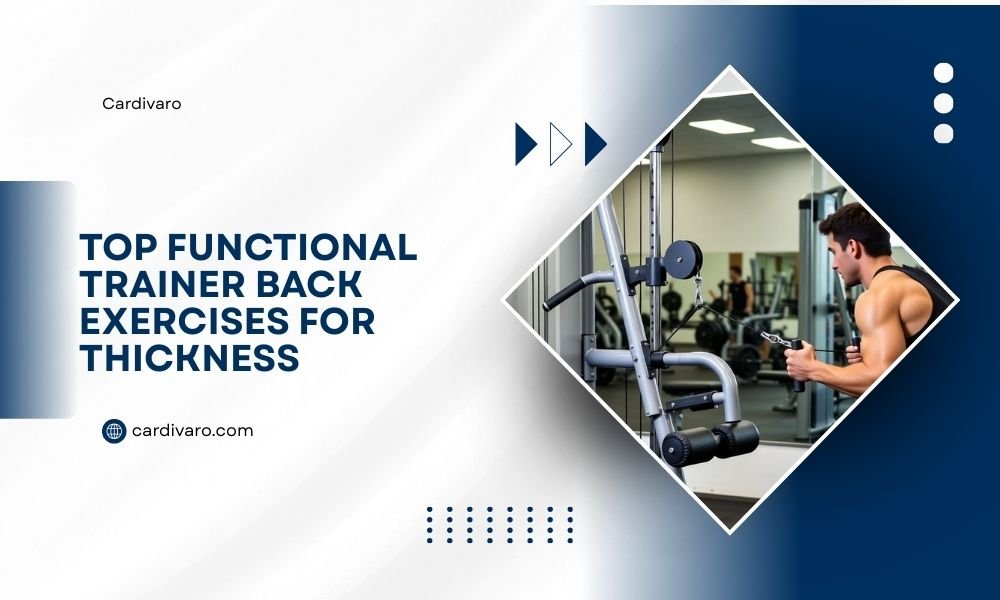
The best functional trainer back exercises for thickness include cable rows, lat pulldowns, reverse flies, and face pulls using various grip positions and angles.
These functional trainer back exercises target your rhomboids, middle traps, and lats to build serious muscle thickness when performed with proper form and progressive overload.
Why Functional Trainers Excel for Back Thickness
You’ve probably noticed that some people have wide backs while others have thick, dense backs. The difference comes down to which muscles you target and how you train them.
Functional trainers give you constant tension throughout each rep. Unlike free weights, the cables don’t let your muscles rest at any point during the movement. This keeps your back muscles working harder for longer.
The adjustable cable heights let you hit your back from every angle. You can target your upper traps, middle traps, rhomboids, and different sections of your lats all in one workout.
Essential Back Thickness Exercises
Seated Cable Rows
This exercise is your bread and butter for back thickness. Set the cables at chest height and grab a narrow grip handle.
Pull the handle to your lower chest while squeezing your shoulder blades together. Hold for one second at the peak contraction. Your elbows should stay close to your body throughout the movement.
Grip Variations That Matter
- Narrow grip: Hits your middle traps and rhomboids harder
- Wide grip: Targets your rear delts and upper back
- Neutral grip: Allows heavier weight and better wrist position
- Underhand grip: Engages your lower lats more
High Cable Rows
Set the cables at the highest position and use a rope attachment. Pull the rope toward your face while separating the ends at your ears.
This movement targets your rear delts, middle traps, and rhomboids. These are the muscles that give your back that thick, dense appearance from behind.
Common Mistakes to Avoid
Don’t let your shoulders roll forward at the start position. Keep your chest up and shoulders back throughout the entire range of motion.
Many people pull too low. Aim for your face or upper chest, not your stomach.
Single-Arm Cable Rows
Working one side at a time lets you focus on muscle imbalances. Set the cable at middle height and step into a split stance.
Pull with one arm while bracing your core. This exercise teaches you to feel each individual lat working.
Advanced Thickness-Building Techniques
Dual Cable Exercises
If your functional trainer has dual cables, you can perform some powerful back exercises. Dual cable rows let you work both sides independently while maintaining perfect balance.
Dual Cable Reverse Flies
Set both cables at shoulder height. Cross your arms in front of your body, then pull both cables back in a wide arc.
This exercise hammers your rear delts and rhomboids. These muscles are often weak in people who spend lots of time sitting.
Cable Y-Raises
Set the cables low and pull them up and out to form a Y shape with your arms. This targets your lower and middle traps, which add thickness to your mid-back.
Angle Variations for Complete Development
Your back has multiple muscle layers. To build true thickness, you need to hit these muscles from different angles.
| Cable Height | Primary Muscles Targeted | Best Exercises |
|---|---|---|
| High | Upper traps, rear delts | Face pulls, high rows |
| Middle | Rhomboids, middle traps | Seated rows, single-arm rows |
| Low | Lower lats, lower traps | Low rows, reverse flies |
Programming for Maximum Thickness
Rep Ranges That Work
Research from the American Council on Exercise shows that moderate rep ranges build the most muscle mass. Aim for 8-12 reps for most of your back thickness work.
Your back muscles respond well to higher volume. You can handle more sets than you might think.
Weekly Volume Guidelines
Start with 12-16 sets per week for your back muscles. Advanced lifters can handle up to 20 sets per week.
Spread this volume across 2-3 back sessions. Your muscles need time to recover between workouts.
Progressive Overload Strategies
Adding weight isn’t the only way to make exercises harder. With cables, you have several options:
- Increase weight by 5-10 pounds when you can complete all sets with perfect form
- Add one extra rep to each set before increasing weight
- Slow down the negative portion of each rep
- Add a pause at the peak contraction
Form Tips for Better Results
Mind-Muscle Connection
Your back muscles are harder to see than your chest or arms. This makes it tougher to know if you’re doing exercises correctly.
Focus on pulling with your elbows, not your hands. Imagine your hands are just hooks connecting your elbows to the weight.
Breathing Pattern
Exhale as you pull the weight toward your body. Inhale as you slowly return to the starting position.
Don’t hold your breath during heavy sets. This can cause dizziness and reduce your performance.
Shoulder Blade Movement
Your shoulder blades should move during back exercises. At the start, let them spread apart slightly. As you pull, squeeze them together.
Think about trying to hold a pencil between your shoulder blades at the top of each rep.
Sample Back Thickness Workout
Here’s a complete functional trainer back workout focused on building thickness:
Workout A: Thickness Focus
- Seated cable rows: 4 sets of 8-10 reps
- High cable rows: 3 sets of 10-12 reps
- Single-arm cable rows: 3 sets of 12 reps each arm
- Cable reverse flies: 3 sets of 12-15 reps
- Face pulls: 2 sets of 15-20 reps
Rest 60-90 seconds between sets. Focus on perfect form rather than heavy weight when starting out.
Troubleshooting Common Issues
Not Feeling Your Back Work
If you only feel your arms during back exercises, you’re probably pulling with your biceps instead of your back muscles.
Try this: do a few reps with very light weight while closing your eyes. Focus on squeezing your shoulder blades together.
Wrist and Forearm Pain
Gripping handles too tightly causes unnecessary tension in your forearms. Hold firmly but don’t death-grip the handles.
Wrist straps can help if grip strength limits your back training. From what I read online, many lifters see better back development once they start using straps for heavier sets.
Plateau Breaking
Stuck at the same weight for weeks? Try changing your grip width or cable height. Small changes can wake up sleeping muscle fibers.
You can also try pre-exhaustion. Do some light reverse flies before your heavy rowing exercises.
Conclusion
Building back thickness with a functional trainer comes down to consistent effort and smart exercise selection. Focus on rowing movements from multiple angles while maintaining perfect form.
Start with the basic seated cable row and master that movement before adding advanced techniques. Your back will respond to the constant tension that cables provide, but only if you’re patient and consistent with your training.
Remember that thickness takes time to develop. Stick with these exercises for at least 8-12 weeks before expecting major changes in your physique.
What’s the difference between back width and back thickness?
Back width comes from your lats spreading out to the sides, while thickness comes from your rhomboids, middle traps, and rear delts building forward from your spine. Width makes you look broader from the front, while thickness makes your back look dense and muscular from the side.
How often should I train my back for thickness gains?
Train your back 2-3 times per week with at least one day of rest between sessions. Your back muscles are large and can handle more volume than smaller muscle groups, but they still need recovery time to grow.
Can I build back thickness without heavy weights?
Yes, functional trainers excel at building muscle with moderate weights and higher volume. Focus on perfect form, controlled movements, and gradually increasing the total amount of work you do rather than just chasing heavier weights.
Why does my lower back hurt during cable rows?
Lower back pain during rows usually means you’re rounding your spine or leaning too far forward. Keep your chest up, shoulders back, and maintain a slight arch in your lower back throughout the movement. Consider using a back support pad if your functional trainer has one.
How long does it take to see back thickness improvements?
You’ll start feeling stronger within 2-3 weeks, but visible thickness changes typically take 6-8 weeks of consistent training. Take progress photos from the side and behind to track improvements, since back changes are harder to see in the mirror than chest or arm development.