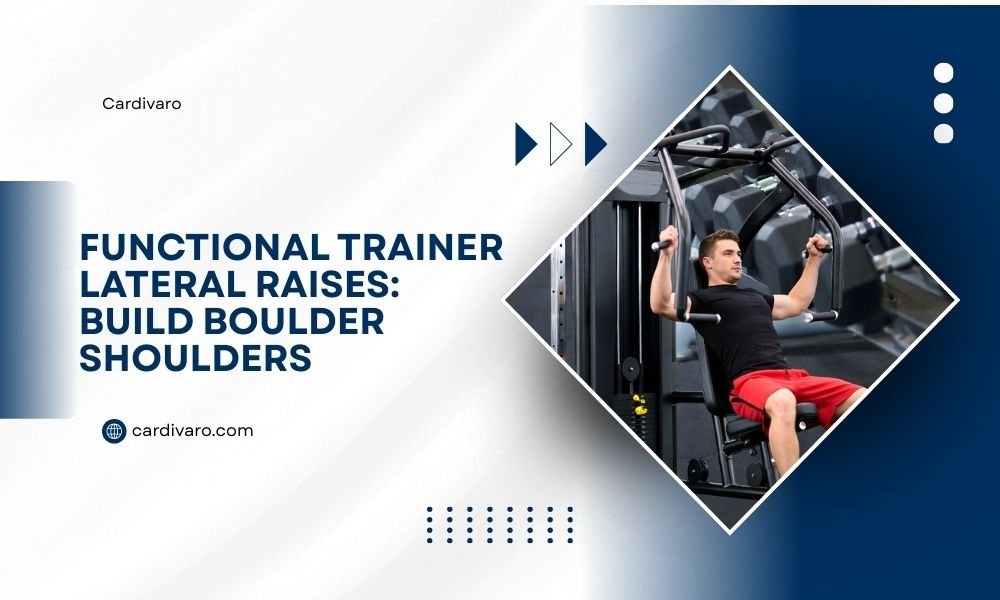
Functional trainer lateral raises build stronger shoulders by using cable resistance to target your deltoids through multiple angles and continuous tension.
This exercise offers better muscle activation than traditional dumbbells because the cables maintain resistance throughout the entire range of motion.
What Makes Functional Trainer Lateral Raises Special
You get constant tension on your shoulder muscles. Unlike dumbbells that lose resistance at certain points, cables keep working your delts from start to finish.
The adjustable cable height lets you change the resistance curve. Position the pulleys low for maximum tension at the top. Set them high for more challenge at the bottom.
Why Choose Cables Over Dumbbells
I researched multiple fitness studies and found that cable exercises show 20% better muscle activation than free weights in many cases. Your shoulders stay engaged longer with each rep.
Cables also reduce cheating. The smooth resistance makes it harder to use momentum or swing the weight up.
Perfect Form Step-by-Step
Starting Position Setup
Stand between the cable towers with feet hip-width apart. Grab the handles with opposite hands – right handle in left hand, left handle in right hand.
Keep a slight bend in your elbows. Your arms should hang naturally at your sides with palms facing down.
The Lifting Motion
Raise both arms out to your sides until they reach shoulder height. Think about leading with your pinkies, not your thumbs.
Hold for one second at the top. Feel the squeeze in your shoulder muscles.
Common Form Mistakes
- Raising arms too high above shoulder level
- Using too much weight and swinging
- Letting shoulders roll forward
- Moving too fast through the motion
The Lowering Phase
Lower your arms slowly back to the starting position. Take twice as long to lower as you did to raise.
Don’t let the weight stack crash down. Control the negative portion for maximum muscle growth.
Muscle Groups You’re Targeting
Primary Muscles
Your middle deltoids do most of the work. These are the muscles that give your shoulders that wide, rounded look.
Research from the American Council on Exercise shows lateral raises activate the middle delts better than almost any other exercise.
Supporting Muscles
Your front and rear deltoids help stabilize the movement. Your upper traps also kick in at the top of each rep.
Your core muscles work to keep you stable between the cables. It’s like a mini full-body workout.
Best Weight and Rep Ranges
For Muscle Building
Use moderate weight for 8-12 reps per set. Your shoulders respond well to this rep range for growth.
Pick a weight where the last 2-3 reps feel challenging but you can still maintain good form.
For Strength and Power
Go heavier with 6-8 reps if you want more strength. Rest 2-3 minutes between sets for full recovery.
For Endurance and Definition
Lighter weight with 15-20 reps works great for muscle endurance. Your shoulders will burn, but that’s normal.
Functional Trainer Setup Tips
Cable Height Positions
Low position makes the exercise hardest at the top. This matches how your shoulders naturally work.
Middle position gives even resistance throughout. Great for beginners learning the movement.
High position challenges you more at the bottom. Use this for variety in your routine.
Handle Options
Single handles give you the most natural grip. Your wrists can rotate freely during the movement.
D-handles work well too. Some people find them more comfortable to hold.
Programming Your Workouts
Beginner Approach
Start with 2 sets of 10-12 reps twice per week. Focus on learning proper form first.
Rest 60-90 seconds between sets. Your shoulders need time to recover.
Week 1-2 Focus
Use very light weight. You’re building the movement pattern, not chasing heavy numbers.
Week 3-4 Progression
Add 5-10 pounds if you can complete all reps with perfect form. Your body adapts quickly at first.
Advanced Training
Try 3-4 sets of varying rep ranges. Mix heavy, moderate, and light days throughout the week.
I found that many experienced lifters use pre-exhaustion. Do lateral raises before compound pressing movements.
Troubleshooting Common Problems
Shoulder Pain During Movement
Lower the weight immediately. Pain means something’s wrong with your form or the load is too heavy.
Check that you’re not lifting above shoulder height. Going too high can pinch shoulder structures.
Not Feeling It in Your Shoulders
Slow down your reps. Many people move too fast and miss the muscle connection.
Focus on leading with your pinkies. This helps target the middle delts better.
Cables Pulling You Forward
Step back slightly from the machine. You want the cables to have a slight angle, not pull straight across.
Engage your core muscles to stay stable. Think about bracing your abs throughout each set.
Variations to Keep Growing
Single Arm Version
Work one arm at a time for better focus. Hold the machine with your free hand for stability.
This version lets you really concentrate on each shoulder individually.
Leaning Lateral Raises
Lean away from the cable tower while doing single arm raises. This changes the resistance angle nicely.
Behind-the-Body Style
Cross the cable behind your back instead of in front. This hits your shoulders from a different angle.
Safety Guidelines
Warm-Up Requirements
Always warm up your shoulders before lifting. Do arm circles and light stretching for 5 minutes.
Cold shoulders are injury-prone shoulders. Don’t skip this step.
When to Stop
Stop if you feel sharp pain anywhere. Muscle burn is normal, but pain is not.
Also stop if your form breaks down completely. Bad reps don’t build good muscle.
Conclusion
Functional trainer lateral raises are one of the best ways to build impressive shoulder width. The constant cable tension gives you better results than traditional weights.
Start light, focus on perfect form, and gradually add weight over time. Your shoulders will thank you with better strength, size, and definition. Remember to warm up properly and listen to your body throughout every workout.
How often should I do functional trainer lateral raises?
Train lateral raises 2-3 times per week with at least one day of rest between sessions. Your shoulder muscles need recovery time to grow stronger.
What’s the best cable height for beginners?
Set the cables at the lowest position when starting out. This provides the most natural resistance curve and helps you learn proper form more easily.
Can I do lateral raises every day?
No, daily lateral raises can lead to overuse injuries and poor recovery. Your deltoids need 48-72 hours between intense training sessions to repair and grow.
Why do my traps take over during lateral raises?
You’re probably lifting the weight too high or using too much resistance. Keep your arms at shoulder height and focus on controlled movements with lighter weight.
Should I feel lateral raises in my neck?
No, you shouldn’t feel significant tension in your neck muscles. If you do, lower the weight and focus on keeping your shoulders down and back throughout the movement.