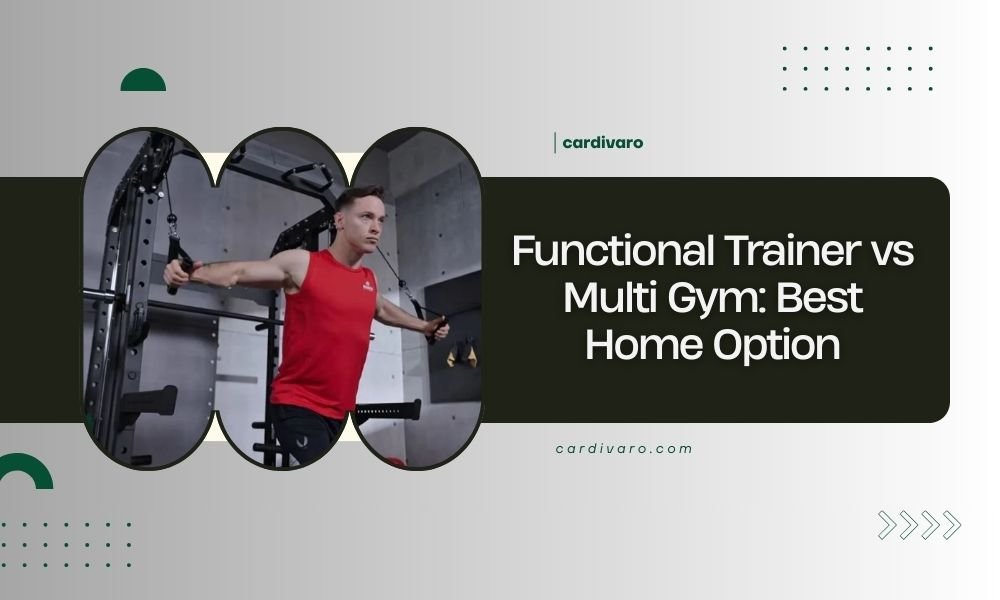
Functional trainers offer cable-based resistance training with multiple exercise options, while multi gyms provide station-based workouts with fixed movement patterns for targeted muscle groups.
Your choice between functional trainer vs multi gym depends on your space, budget, and workout preferences – functional trainers excel at natural movements while multi gyms focus on isolated strength training.
What Makes Functional Trainers Different
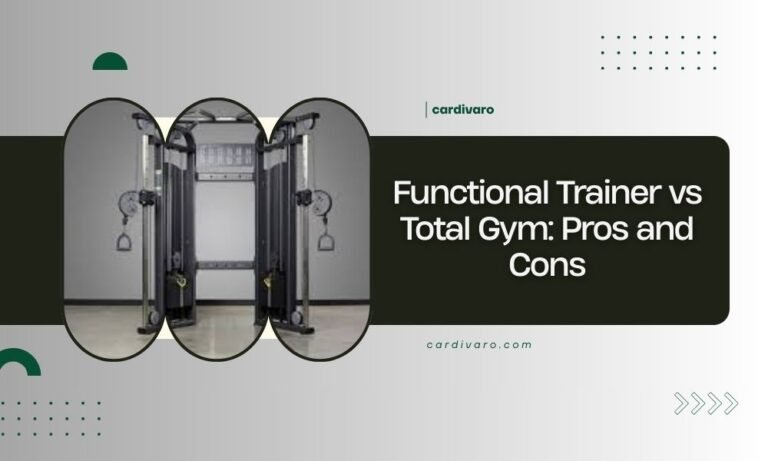
Functional trainers use adjustable cable systems that move in all directions. Think of them as your personal gym trainer that adapts to any exercise you want to do.
The cables adjust to different heights and angles. You can perform squats, rows, chest presses, and rotational movements all on one machine.
Key Features of Functional Trainers
- Dual adjustable cable columns
- Multiple attachment points (usually 10-25)
- Various handle attachments
- Weight stack or plate loading options
- Pull-up bars on most models
Cable System Advantages
Cable resistance feels different from free weights. The tension stays constant throughout your entire range of motion.
You can train explosive movements safely. Cable systems let you perform athletic movements like wood chops and medicine ball throws without actual balls flying around your home.
Space Requirements
Most functional trainers need about 8×8 feet of floor space. You need extra room to move around and extend the cables fully.
Understanding Multi Gym Systems
Multi gyms combine several exercise stations into one compact unit. Picture a traditional gym condensed into a single machine.
Each station targets specific muscle groups. You move from the lat pulldown to chest press to leg extension without changing machines.
Multi Gym Components
- Lat pulldown station
- Chest press and fly station
- Low row attachment
- Leg extension and curl
- High and low pulley systems
Station-Based Training
Each station guides your movement path. This makes multi gyms great for beginners who want proper form without a personal trainer.
The fixed paths also mean faster workouts. You spend less time adjusting equipment and more time exercising.
Weight Stack Systems
Multi gyms typically use selectorized weight stacks. You pick your weight by moving a pin – no loading plates or adjusting cables.
Direct Comparison: Performance and Function
| Feature | Functional Trainer | Multi Gym |
|---|---|---|
| Exercise Variety | 200+ exercises possible | 15-25 exercises typically |
| Learning Curve | Moderate to steep | Beginner-friendly |
| Workout Speed | Slower setup between exercises | Quick station changes |
| Natural Movement | Excellent for real-world motions | Fixed movement patterns |
Strength Building Potential
Multi gyms excel at building raw strength. The fixed paths let you focus purely on moving heavy weight.
Functional trainers build functional strength. You develop the small stabilizer muscles that multi gyms often miss.
Progressive Overload Options
Both systems handle progressive overload well. Multi gyms use simple weight stack progression.
Functional trainers let you progress by changing angles, adding instability, or combining movements.
Space and Installation Factors
Footprint Comparison
Multi gyms pack more exercises into less space. A quality multi gym fits in a 6×8 foot area.
Functional trainers need more surrounding space. You need room to step back, move laterally, and swing the cables.
Ceiling Height Requirements
Both machines need 8-9 feet of ceiling height minimum. Some functional trainer exercises work better with 10+ feet.
Assembly Complexity
Multi gyms take 6-12 hours to assemble. The multiple stations and cables create complexity.
Functional trainers usually assemble faster – 4-8 hours for most models.
Long-term Durability
Multi gyms have more moving parts that can wear out. Pulleys, cables, and adjustment mechanisms need regular maintenance.
Quality functional trainers often last longer. The simpler cable system has fewer failure points.
Cost Analysis
Initial Investment
Entry-level multi gyms start around $800-1200. Quality home models run $2000-4000.
Functional trainers begin around $1500 for basic models. Commercial-grade home units cost $3000-8000.
Hidden Costs
Both machines may need professional assembly ($200-500). Factor in floor mats and possible electrical work for lighting.
Maintenance Expenses
Multi gyms need more frequent cable and pulley replacements. Budget $100-200 annually for parts.
Functional trainers typically need less maintenance. Cable replacement every 2-3 years costs $50-100.
Who Should Choose Each Option
Functional Trainers Work Best For
- Athletes wanting sport-specific training
- People with workout experience
- Those focused on functional fitness
- Users who get bored easily
- Homes with generous space
Ideal User Profile
You love variety and challenges. You want to train movements, not just muscles.
You have experience with cable machines or don’t mind learning. You prefer adaptable equipment over simple solutions.
Multi Gyms Suit These Users
- Beginners to strength training
- People wanting quick workouts
- Users focused on muscle building
- Those with limited space
- People who like routine
Perfect Multi Gym Candidate
You want straightforward strength training. You prefer guided movements over free-form exercises.
You value efficiency and like completing full-body workouts in 30-45 minutes.
Making Your Final Decision
Consider your primary fitness goals first. Want to build muscle mass? Multi gyms deliver targeted muscle work.
Training for sports or real-world activities? Functional trainers provide better movement preparation.
Test Before You Buy
Visit local fitness stores or gyms. Spend 20 minutes trying both machine types.
Pay attention to which exercises feel natural. Notice which system motivates you more during the trial.
Consider Your Learning Style
Some people thrive with structure and guidance. Others prefer creativity and adaptation.
Multi gyms provide structure. Functional trainers reward creativity and experimentation.
Conclusion
Your choice between functional trainer vs multi gym depends on your fitness goals, space, and workout preferences. Multi gyms excel at straightforward strength building with guided movements and efficient workouts. Functional trainers shine for athletic training, movement variety, and real-world strength development.
Both options can transform your home fitness routine. Choose the multi gym if you want simple, effective strength training. Pick the functional trainer if you crave exercise variety and functional movement patterns. Either way, you’re investing in your long-term health and fitness success.
Can I build the same muscle mass with a functional trainer as a multi gym?
Yes, functional trainers can build equivalent muscle mass through progressive cable resistance. The key difference is that functional trainers require more technique knowledge to target muscles effectively, while multi gyms guide you through muscle-specific movements automatically.
Which machine requires less maintenance over time?
Functional trainers typically need less maintenance due to simpler cable systems with fewer moving parts. Multi gyms have more pulleys, adjustment mechanisms, and connection points that can wear out or need lubrication over time.
Do functional trainers work for complete beginners?
Functional trainers work for beginners but require more learning time initially. You need to understand cable angles, attachment points, and proper form for various movements. Multi gyms offer more intuitive, guided exercises that beginners can master quickly.
Which option takes up less actual floor space in my home?
Multi gyms have a smaller physical footprint, but functional trainers need significantly more surrounding space for cable movements and exercises. A multi gym fits in tighter spaces, while functional trainers work best in open areas like garages or large basements.
Can either machine replace a full gym membership completely?
Both machines can replace most gym functions for strength training, but you’ll miss cardio equipment variety and some specialized machines. Functional trainers come closer to full gym replacement due to their exercise versatility, while multi gyms excel at replicating traditional weight machine workouts.