What Is the Difference Between a Functional Trainer and a Smith Machine?
On this page (5 sections)
The main difference between a functional trainer and a Smith machine lies in their movement patterns and versatility. A functional trainer offers free, multi-directional movement using cable pulleys, while a Smith machine restricts you to a fixed, vertical path for barbell exercises.
You might be wondering which one is better for your workouts. We found that each machine offers distinct advantages for your strength training goals. Understanding these differences can help you choose the right equipment for your home gym or commercial facility, leading to more effective and safer workouts.
- Functional trainers allow for natural, multi-planar movements.
- Smith machines provide safety with a fixed bar path and spotter hooks.
- Functional trainers build real-world strength and stability.
- Smith machines are great for isolation exercises and heavy lifting.
- Both have pros and cons depending on your fitness goals.
Let’s walk through exactly how these two popular gym machines compare, so you can make an informed decision for your fitness journey.
Comparing Functional Trainers and Smith Machines
Understanding the core mechanics of a functional trainer versus a Smith machine is key to making the best choice for your fitness goals. We found that each machine excels in different areas, offering distinct benefits for your strength and overall fitness.
Functional Trainers: Freedom in Motion
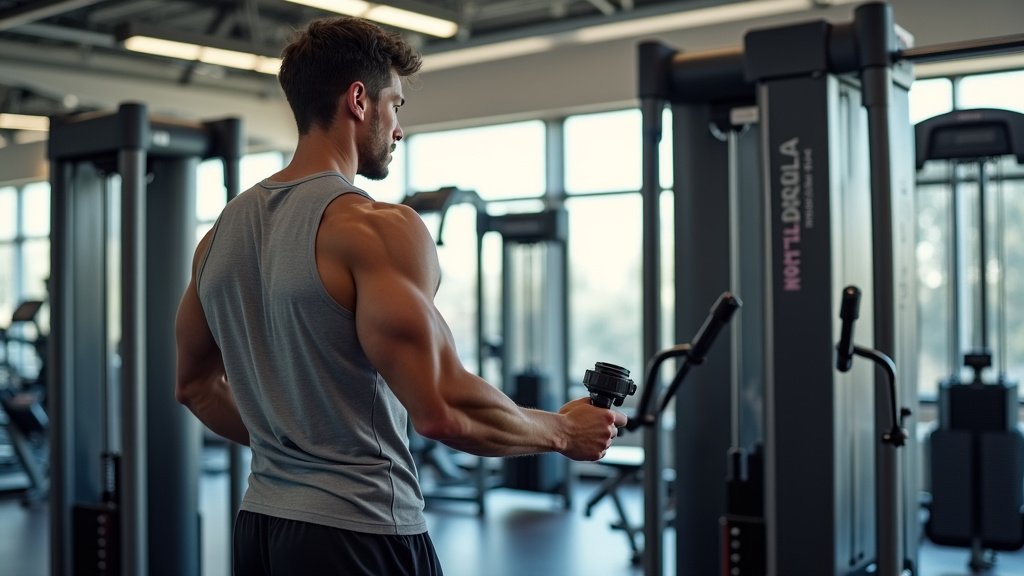
Imagine a gym machine that lets your body move naturally. That’s essentially what a functional trainer offers. It uses a system of cables and pulleys, allowing for a wide range of motion. You can push, pull, rotate, and lift in almost any direction.
The Mechanics of a Functional Trainer
A functional trainer typically features two adjustable pulley columns. You can set the pulleys at various heights, from floor level to above your head. This flexibility means you can perform exercises from different angles. You’re constantly engaging your stabilizer muscles with every movement.
- Adjustable pulleys offer endless exercise variations.
- Cables provide constant tension throughout the movement.
- Allows for multi-directional, natural human movement.
- Engages core and stabilizing muscles more effectively.
Think about throwing a ball or reaching for something on a high shelf. These are multi-planar movements. A functional trainer lets you mimic these real-life actions, building strength that translates directly to your daily activities (National Institutes of Health).
Benefits of Using a Functional Trainer
The biggest advantage of a functional trainer is its ability to improve functional strength. This is the strength you use for everyday tasks, sports, and preventing injuries. Because the cables allow for free movement, your body has to work harder to control the weight.
We found that people often experience better overall body awareness and coordination with consistent use. It’s excellent for rehabilitation too, as it can target specific muscles without putting excessive stress on joints. Many physical therapists use functional trainers for controlled, precise movements.
Smith Machines: Guided Strength
Now, let’s talk about the Smith machine. This machine is very different from a functional trainer. It features a barbell fixed within steel rails, allowing it to move only in a straight vertical path. Think of it as a barbell on a very specific track.
How a Smith Machine Operates
The barbell on a Smith machine has hooks that can be engaged with safety pins along the uprights. This means you can “rack” the weight at any point during your lift. It provides a built-in spotter, making it a favorite for those lifting heavy or training alone.
- Fixed vertical bar path for guided movement.
- Safety hooks allow you to stop the lift at any point.
- Reduces the need for stabilizer muscles.
- Excellent for isolation exercises and pushing your limits.
Because the bar path is fixed, you don’t need to worry about balancing the weight yourself. This allows you to focus purely on pushing or pulling the load, often enabling you to lift more weight than you might with a free barbell.
Advantages of the Smith Machine
Safety is a primary benefit of the Smith machine, especially when performing exercises like squats or bench presses without a spotter. You can push your muscles to failure with less risk of injury. It’s also fantastic for isolation exercises, where you want to target a specific muscle group without other muscles taking over.
For example, if you’re trying to build your quadriceps, a Smith machine squat can help you focus solely on that muscle group. We found that beginners often appreciate the guided movement as it helps them learn proper form for certain exercises before moving to free weights.
Key Differences at a Glance
To help you quickly grasp the main distinctions, let’s look at a side-by-side comparison. This table highlights the fundamental ways these two machines operate and what they offer you in your workouts.
| Feature | Functional Trainer | Smith Machine |
|---|---|---|
| Movement Path | Free, multi-directional (3D) | Fixed, vertical only (1D) |
| Muscle Engagement | Full body, high stabilizer engagement | Primary muscles, low stabilizer engagement |
| Exercise Variety | Very high (hundreds of exercises) | Moderate (primarily barbell exercises) |
| Safety Features | Controlled movement, lighter weights often | Built-in safety hooks, fixed path |
| Primary Goal | Functional strength, stability, athleticism | Muscle isolation, heavy lifting, strength |
| Skill Level | Intermediate to advanced generally | Beginner to advanced |
Movement and Muscle Activation
This is arguably the most significant difference. With a functional trainer, you’re performing natural, unrestricted movements. Your body has to stabilize itself, engaging your core and many smaller supporting muscles. This leads to more overall muscle activation, which is great for improving balance and coordination (American Council on Exercise).
On the flip side, the Smith machine’s fixed path means your body doesn’t need to work as hard on stabilization. This allows you to lift heavier weights for specific muscle groups. It’s a trade-off: more weight lifted versus more muscles engaged.
Safety and Spotting
Both machines offer safety benefits, but in different ways. The Smith machine provides an immediate safety net with its hooks, letting you stop a lift if you fail. This is particularly appealing for heavy presses and squats when you’re training alone. You simply rotate the bar and catch it on the nearest hook.
A functional trainer’s safety comes from its inherent design. You’re typically not lifting dangerously heavy loads that could crush you. If you need to stop an exercise, you simply let go of the handles. The weights are usually controlled through selectorized stacks, which are much safer than dropping heavy free weights.
Versatility and Exercise Range
When it comes to exercise variety, the functional trainer is a clear winner. We found that you can perform hundreds of exercises, targeting almost every muscle group from every angle. Think chest presses, rows, bicep curls, tricep extensions, wood chops, rotational movements, leg abduction, and so much more. You can even do pull-ups or bodyweight rows with the right attachments.
The Smith machine, while great for its purpose, is more limited. It excels at barbell-based movements like squats, bench presses, overhead presses, and rows. However, because of the fixed path, some natural movements are awkward or even unsafe to perform. For example, a true deadlift is generally not recommended on a Smith machine due to the unnatural bar path.
Which Machine is Right for Your Goals?
Choosing between a functional trainer and a Smith machine depends heavily on what you want to achieve. Are you looking to build raw strength in specific lifts, or improve overall athleticism and daily functional movement? Consider your current fitness level and your long-term objectives.
Consider Your Fitness Level and Experience
For beginners, a Smith machine can be a good starting point to learn basic movement patterns for exercises like squats and bench presses. The guided path helps you feel the muscles working without worrying about stability. However, it’s important to transition to free weights or functional movements once you’ve mastered the form to build true functional strength.
Intermediate and advanced lifters might find more utility in a functional trainer for adding variety, improving athletic performance, and addressing muscle imbalances. It challenges your body in ways that fixed-path machines cannot. We often see experienced athletes incorporating functional training into their routines for peak performance.
Evaluate Your Workout Preferences
Do you enjoy the feeling of lifting heavy and pushing your limits on big compound movements? The Smith machine might be a satisfying addition to your home gym or a valuable tool in your commercial gym. Do you prefer dynamic movements, working multiple muscle groups at once, and improving your overall body control? Then a functional trainer will likely be your preferred choice.
Many gym-goers appreciate the ease of changing weights on both machines. Selectorized weight stacks on functional trainers are quick and convenient. The Smith machine’s plate-loaded design is familiar to anyone who’s used a barbell.
Checklist: Deciding Between Machines
Still on the fence? Ask yourself these questions to help clarify your needs:
- Are you primarily focused on building muscle size and isolating specific groups?
- Do you often lift alone and need built-in safety features?
- Is your main goal to improve functional strength for daily activities or sports?
- Do you want to perform a wide variety of exercises with one machine?
- Is balance, coordination, and core stability a priority for your training?
- Are you recovering from an injury and need controlled, low-impact movements?
If you answered “yes” to the first two, the Smith machine might be a better fit. If you leaned towards the latter four, a functional trainer is likely more aligned with your objectives.
Conclusion
Choosing between a functional trainer and a Smith machine really comes down to your personal fitness journey and what you aim to achieve. We found that the functional trainer excels in versatility and building real-world strength through free movement. The Smith machine offers unmatched safety for heavy lifting and muscle isolation.
Neither machine is inherently “better.” Your ideal choice depends on your goals for movement, safety, and exercise variety. Think about your priorities and use this guide to confidently select the right equipment for your workouts. Get ready to train smarter and more effectively!
Frequently Asked Questions
Can I get a full-body workout with just a functional trainer?
Yes, absolutely! A functional trainer allows for hundreds of exercises. You can target every major muscle group, including your core and stabilizer muscles. Its versatility makes it a great single-machine solution for comprehensive fitness.
Is a Smith machine only for advanced lifters?
Not at all. While advanced lifters use it for heavy isolation, beginners can also benefit. The fixed bar path helps you learn proper movement patterns with less risk. It can be a good stepping stone before moving to free weights.
Which machine is better for burning calories?
Calorie burning primarily depends on the intensity and duration of your workout, not just the machine. A functional trainer might engage more muscles, leading to higher energy expenditure. However, an intense workout on a Smith machine can also burn many calories.
Can I use resistance bands with these machines?
Resistance bands can certainly be incorporated. With a functional trainer, you can add bands to handles or anchors for varied resistance. On a Smith machine, bands can be looped around the bar and floor for accommodating resistance, increasing the challenge at different points in the lift.
What’s the typical footprint size for each machine?
Functional trainers usually require a wider space, around 8-10 feet wide, to allow for full range of motion exercises. Smith machines are generally narrower, but taller. They often need about 6-8 feet in width and 7-8 feet in height. Always check specific model dimensions.