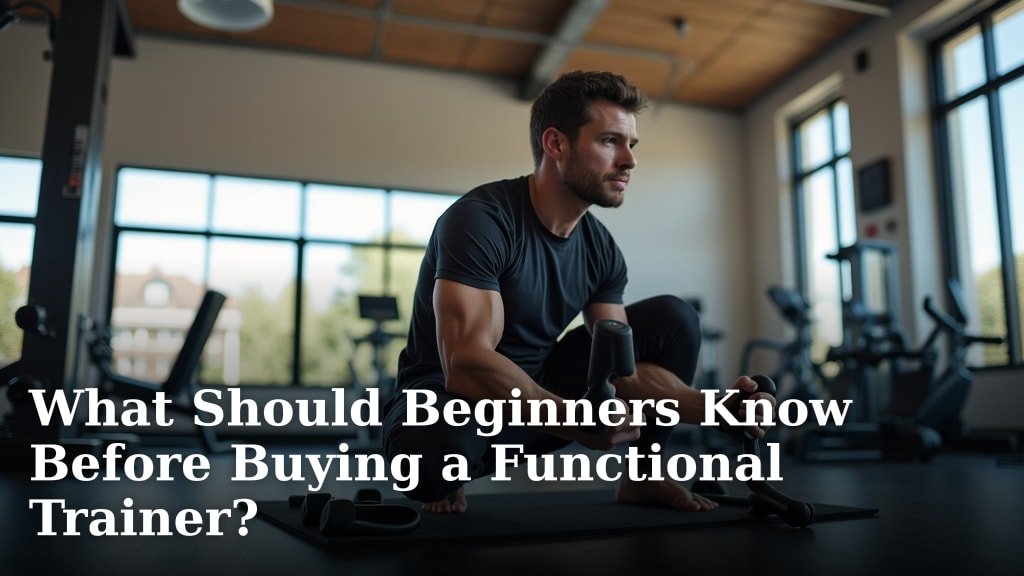
Before buying a functional trainer, you should know these machines offer incredible workout versatility but also come with a higher price tag and require ample space. We found many beginners overlook the need for proper setup and calibration. You want to make sure your choice fits your fitness goals and living situation.
These cable machines let you do hundreds of exercises, targeting every muscle group. Think about your available space, your budget, and the specific features you truly need. Are you looking for strength training, rehab, or general fitness? Consider long-term durability and warranty too.
- Functional trainers offer massive exercise variety.
- They can be a big investment.
- Space requirements are often underestimated.
- Consider features like pulley ratios and weight stacks.
- Durability and warranty are key for home gym equipment.
Ready to make an informed decision? Let’s walk through everything you need to know before investing in a functional trainer.
Understanding Your Functional Trainer Investment
Before you commit to buying a functional trainer, it’s essential to grasp what these machines truly offer and what they demand from you. We’ve found that many beginners jump in without fully understanding the nuances.
What Exactly is a Functional Trainer?
A functional trainer is a versatile cable machine with adjustable pulleys. These pulleys allow you to pull cables from various angles. This design mimics natural body movements, helping you build real-world strength. You can perform exercises in multiple planes of motion, unlike traditional weight machines that often restrict movement.
Think of it as a gym packed into one footprint. You can target almost every muscle group for strength, balance, and flexibility. It’s not just for big lifts; it’s excellent for rehabilitation and improving sports performance too (American Council on Exercise).
Why Choose a Functional Trainer Over Other Equipment?
You might be wondering, “Why this and not just free weights?” We’ve seen functional trainers offer a unique advantage: constant tension. Unlike dumbbells or barbells, cables keep your muscles engaged throughout the entire movement. This can lead to different types of muscle growth and endurance.
They also provide safer resistance. If you drop a dumbbell, it can be dangerous. If you let go of a cable, it simply retracts. This makes them a great option for solo workouts, especially when you’re still learning proper form. Plus, the sheer variety of exercises keeps your workouts fresh and engaging.
Key Considerations Before Your Purchase
Buying a functional trainer isn’t like picking up a set of dumbbells. There are several big factors you absolutely need to weigh. We found that ignoring these leads to buyer’s remorse.
Space Requirements: Measure Twice, Buy Once
This is probably the most overlooked aspect. Functional trainers are not small. They need a dedicated space in your home gym or workout area. You need to consider not just the machine’s footprint, but also the space around it for movement.
- Width: Most units are 4-6 feet wide.
- Depth: You’ll need at least 3-4 feet in front and behind for full range of motion.
- Height: Ceiling height is critical, typically 7-8 feet, especially if you plan overhead exercises.
We recommend mapping out the space with painter’s tape on your floor. Walk around it, imagine doing exercises. Does it feel cramped? If so, you might need to reconsider your options or your location.
Budgeting for Your Functional Trainer
Functional trainers represent a significant investment. Prices can range widely, from around $1,500 for entry-level models to over $5,000 for commercial-grade units. We’ve found that beginners often underestimate the total cost.
Think about your long-term fitness goals. Is this a machine you’ll use for years? If so, investing a bit more upfront for quality and durability can save you money down the road. Cheaper models might lack features or break down faster, costing you more in repairs or replacement.
Understanding Weight Stacks and Ratios
This sounds technical, but it’s important. Functional trainers use weight stacks and a pulley system. The weight stack is the total amount of weight plates available. However, due to pulley ratios, you don’t lift the full weight shown.
Most functional trainers have a 2:1 pulley ratio. This means if you select 100 lbs on the stack, you’re only lifting 50 lbs of resistance at the handle. Some might have a 1:1 or 4:1 ratio. We recommend understanding this ratio because it directly impacts the effective resistance you’re working with. If you’re a strong lifter, a higher stack might be necessary to get enough resistance at a 2:1 ratio.
Here’s a quick table to help you visualize:
| Selected Weight on Stack | Pulley Ratio | Effective Resistance | Best For |
|---|---|---|---|
| 100 lbs | 2:1 | 50 lbs | General fitness, beginners, rehab |
| 100 lbs | 1:1 | 100 lbs | Advanced strength, heavier lifts |
| 100 lbs | 4:1 | 25 lbs | Rehab, very light resistance exercises |
Consider your current strength levels and future strength goals. Do you need a machine that offers very light resistance for recovery, or heavy resistance for strength training? This will guide your choice of weight stack size and pulley ratio.
Features and Accessories That Matter
Once you’ve got the basics down, you can start looking at the bells and whistles. Some features are genuinely helpful, while others might be overkill for a beginner.
Adjustability and Ease of Use
You want a machine that’s easy to adjust. How quickly can you change the pulley height? Are the pins smooth? We found that models with quick-release pins or gas-assisted adjustments make for a much more enjoyable workout experience. If it’s a hassle to adjust, you might skip exercises.
Consider the number of pulley positions. More positions mean more exercise variety and better customization for your body height. Some trainers also have adjustable width, which is great for different exercise types.
Included Accessories and Attachments
Most functional trainers come with a basic set of accessories: two D-handles, perhaps an ankle strap, and a triceps rope. This is usually enough to get you started. However, you might want to look for models that include:
- Straight bar for bicep curls and triceps pushdowns.
- Lat pull-down bar.
- Longer bars for squats or deadlifts.
- Weight storage pegs for organizing your plates if it’s a plate-loaded model.
You can always buy these separately, but it’s often cheaper if they come bundled. We recommend thinking about the exercises you want to do and checking if the necessary attachments are included or easily purchased.
Durability, Warranty, and Assembly
Don’t overlook the practical aspects of owning a large piece of gym equipment. These factors impact your long-term satisfaction.
Build Quality and Warranty Protection
A functional trainer should be built to last. Look for machines made from heavy-gauge steel. Check reviews for comments on wobbling or flimsiness. A solid, stable machine feels safer and performs better.
The warranty is your safety net. We recommend looking for a good warranty on the frame (often lifetime) and at least 1-5 years on parts and cables. This tells you the manufacturer stands behind their product. A good warranty shows confidence in the machine’s durability, which is important for such an investment.
Assembly Process: DIY or Professional?
These machines can be complex to assemble. Some brands are known for clear instructions and easy assembly, while others can be a nightmare. We found many users underestimate the time and effort involved.
Do you have the tools, the time, and perhaps a friend to help? Many larger units can take 4-8 hours to assemble, sometimes more. Some retailers offer professional assembly services, which might be a worthwhile added cost to save you frustration and ensure it’s built correctly. Always check reviews for comments on assembly difficulty.
Your Beginner’s Functional Trainer Checklist
Before you hit “buy,” use this quick checklist to make sure you’ve covered your bases. We want you to feel confident in your decision!
- Have I accurately measured my available space for the machine AND for movement around it?
- Does the price align with my budget and long-term fitness goals?
- Do I understand the weight stack size and pulley ratio, and will it provide enough resistance for me?
- Are the adjustments easy to make, and are there enough pulley positions for my desired exercises?
- Are the essential attachments included, or am I prepared to purchase them separately?
- Does the machine have a robust warranty and positive reviews regarding its build quality?
Conclusion
Choosing your first functional trainer is a big step towards a more versatile home workout. We’ve walked through the essential considerations, from measuring your space to understanding weight ratios and warranties. Remember, this isn’t just about buying a machine; it’s about investing in your fitness journey.
By carefully evaluating your needs, budget, and the machine’s features, you can avoid common pitfalls. Don’t rush the decision. Take your time, use our checklist, and find the perfect fit for your home gym. Your future self will thank you for making an informed choice.
Now, go forth and transform your training!
Frequently Asked Questions
Is a functional trainer good for beginners?
Yes, functional trainers are excellent for beginners. They offer controlled resistance, which helps you learn proper form more safely than free weights. The adjustability allows you to start with very light resistance and gradually increase it as you get stronger.
Can you build a lot of muscle with a functional trainer?
Absolutely. While often associated with lighter, functional movements, functional trainers can provide significant resistance for muscle building. With the right exercises and progressive overload, you can achieve substantial strength and hypertrophy gains. Look for models with higher effective resistance if this is your primary goal.
How much space do I really need for a functional trainer?
You need more than just the machine’s footprint. We recommend at least 4-6 feet in width and enough depth to move freely, often 3-4 feet in front and behind the unit. Don’t forget ceiling height – 7 to 8 feet is usually sufficient for overhead movements.
Are functional trainers noisy?
Generally, functional trainers are quieter than many other gym machines, like treadmills or rowing machines. The cables and weight stacks move smoothly. You might hear a slight clang as weights settle, but they are not typically considered loud, making them good for home use.
What’s the main difference between a functional trainer and a Smith machine?
A functional trainer uses cables with adjustable pulleys, allowing for free, multi-directional movements that mimic real-life actions. A Smith machine, however, has a barbell fixed on vertical rails, limiting movement to a strict up-and-down path. This difference impacts muscle engagement and exercise versatility.